The Elenchus of History: September 11 and the Weight of “What If?”
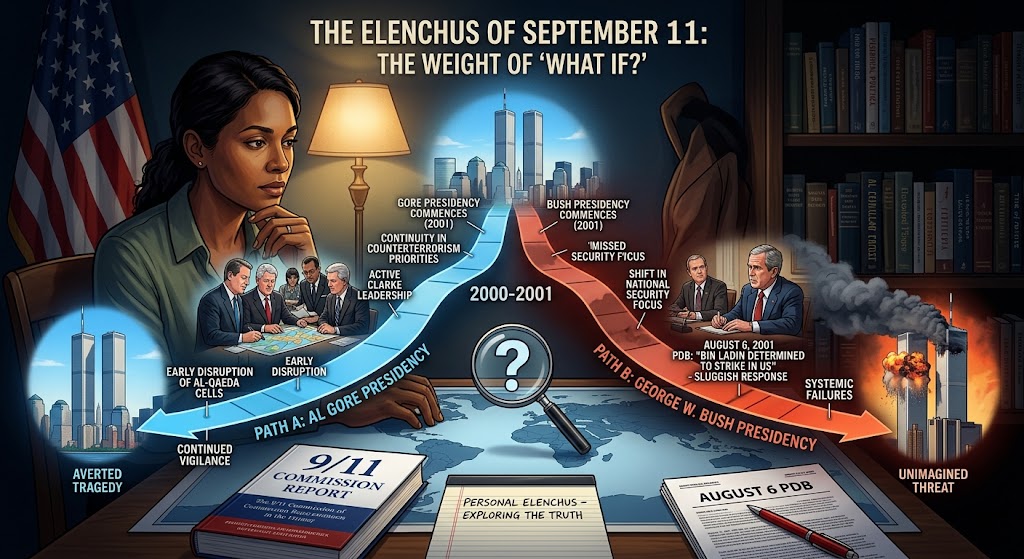
Welcome back to A Personal Elenchus. The Socratic method of elenchus is about cross-examination—peeling back the layers of our assumptions to seek a deeper truth. Today, on the anniversary of September 11, we are turning that lens toward one of the most painful and debated counterfactuals in modern American history: the transition of power in 2000, and whether the tragedy could have been averted under different leadership.
When we look back at the devastation of that day, it is a natural human instinct to search for the pivot points where history might have been diverted. What if the Supreme Court had ruled differently in Bush v. Gore? What if the institutional knowledge of the Clinton administration had been more deeply integrated into the incoming Bush White House?
The Continuity of Intelligence
The argument that a Gore presidency might have altered the timeline hinges heavily on the continuity of national security priorities. By the end of his second term, President Bill Clinton and his national security team, particularly counterterrorism czar Richard Clarke, had become acutely focused on the threat posed by Osama bin Laden and Al-Qaeda.
During the transition, Clinton’s team urgently tried to impress upon the incoming Bush administration that Al-Qaeda was the most significant immediate threat to the United States. Critics of the Bush administration often argue that this transition was marked by a fatal shift in focus. The incoming Bush team, shaped by Cold War paradigms, initially prioritized state actors, missile defense, and Iraq, rather than the asymmetric threat of stateless terrorist networks.
For those engaging in this historical what if, the premise is that Al Gore, having been embedded in the Clinton administration’s escalating shadow war with Al-Qaeda, would have maintained Clarke’s urgency. The theory suggests a Gore White House might have immediately aggressively pursued the intelligence chatter in the summer of 2001, potentially disrupting the plot.
The August 6 Briefing and the Question of Carelessness
The lens of cross-examination also falls heavily on the summer of 2001. Historians and critics point to the now-infamous Presidential Daily Brief (PDB) delivered to President George W. Bush on August 6, 2001, titled “Bin Ladin Determined To Strike in US.”
Critics argue that the Bush administration’s response to this briefing—and the broader blinking-red intelligence matrix of that summer—was dangerously sluggish, characterizing it as careless leadership that failed to marshal the FBI, CIA, and FAA into a state of high alert. The elenchus here asks us to consider whether a different commander-in-chief would have reacted to that specific briefing by shaking the bureaucracy awake and demanding immediate domestic sweeps.
The 9/11 Commission and Systemic Failures
However, true Socratic inquiry requires us to look at the entire board. When the bipartisan 9/11 Commission released its exhaustive report, it painted a picture of a tragedy born not just from the decisions of a few months, but from years of systemic, institutional failure that spanned both the Clinton and Bush administrations.
The Commission highlighted massive structural barriers, most notably the “wall” that legally and culturally prevented the CIA and the FBI from sharing critical intelligence with one another. Even with active leadership, the machinery of American intelligence was heavily fragmented.
The report noted that while the Clinton administration recognized the threat, they also missed opportunities to eliminate bin Laden or fundamentally restructure the intelligence community to handle the evolving nature of global terrorism. Ultimately, the Commission concluded that the government across multiple administrations failed to imagine the magnitude of the threat.
The Limits of Counterfactuals
The tragedy of an elenchus is that it often leaves us with more questions than answers. We know that the transition from Clinton to Bush resulted in a shift in national security priorities during a critical window. We know that urgent warnings were sounded and, tragically, not acted upon with the necessary force to stop the hijackers.
But history is notoriously resistant to clean counterfactuals. Whether Al Gore’s presence in the Oval Office could have single-handedly overcome the deeply entrenched bureaucratic walls that blinded American intelligence will forever remain an unanswerable question.
What we can do, rather than just relitigate the past, is apply this cross-examination to the present. The ultimate lesson of September 11 and the transitions of power is that the institutions designed to protect us are only as strong as the imagination, urgency, and collaboration of the people leading them.


 A Personal ELENCHUS