The Idol and the Soul: Why I Left the Political Tribe
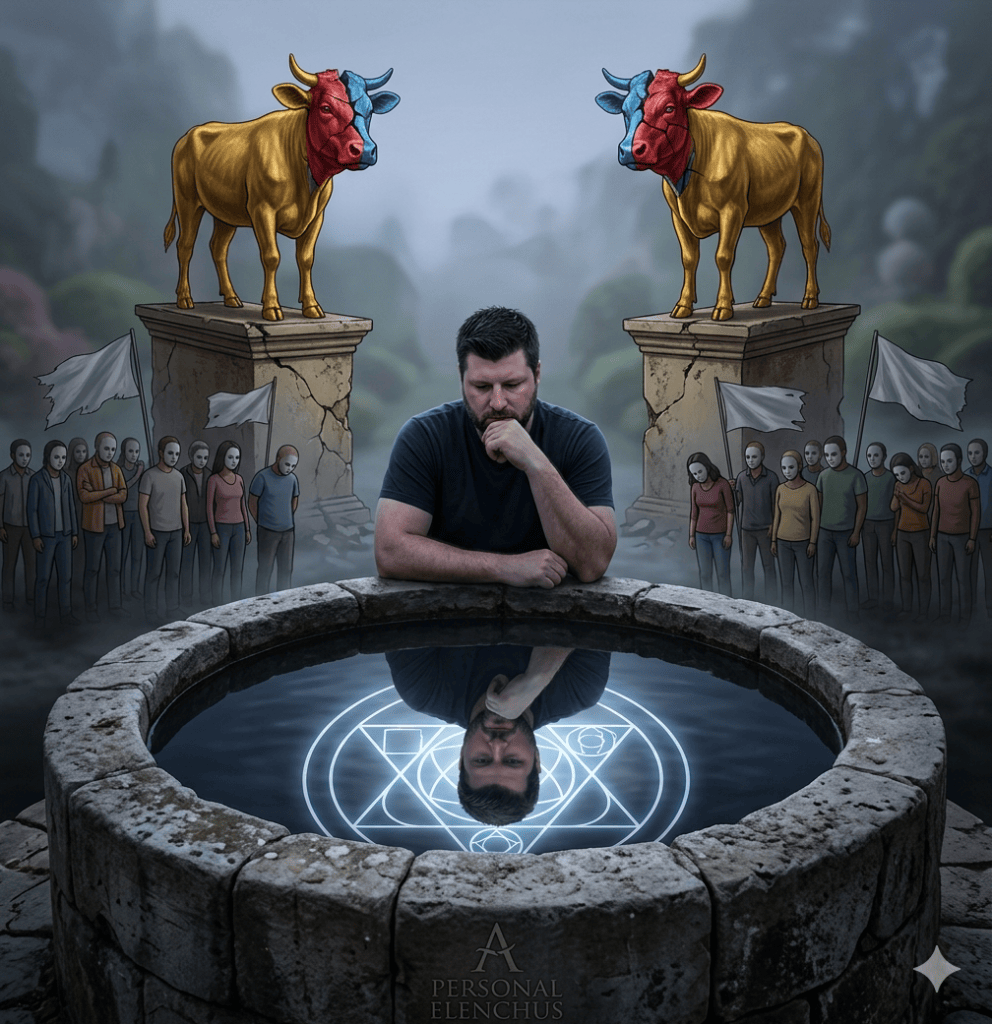
For a long time, I believed that my political identity was a proxy for my moral compass. I wore my affiliations like armor, convinced that the battle lines of my chosen ideology were the definitive boundaries between good and evil. To be engaged, to be angry, to be fiercely loyal to the “right” side—I mistook this for virtue.
But the premise of this blog is the *Elenchus*—the Socratic method of ruthless, loving cross-examination. It is the art of asking the questions that dismantle our false certainties. Recently, I turned the elenchus inward. I put my own political devotion on the witness stand, and what I found was deeply unsettling.
Here is how the interrogation went.
## The Internal Elenchus
> **The Question:** Why do I defend this political faction so fiercely?
> **The Answer:** Because their platform aligns with what is good and just. The other side promotes harm.
> **The Question:** Does the faction I defend act justly in *every* instance? Are their leaders without moral failing?
> **The Answer:** Well, no. They are human. They make mistakes, and sometimes they act out of political expediency rather than moral clarity.
> **The Question:** When they act out of expediency or malice, do I condemn them with the same ferocity that I condemn the other side?
> **The Answer:** …No. I tend to excuse it, downplay it, or justify it as a necessary evil to win the larger war.
> **The Question:** If I am willing to sacrifice my own understanding of “the good” to protect the reputation of a politician, am I actually aligned with the truth? Or am I just serving a master?
>
That final question broke the illusion. The Socratic aporia—that state of profound, paralyzing doubt—set in. I realized I was not a seeker of truth; I was a partisan foot soldier.
## The Shame of the Golden Calf
When we tie our identities to political factions, we inevitably fall into idol worship. And let us be brutally honest: this is true of *both* sides of the aisle. We take deeply flawed, compromised human beings—people actively seeking power—and we elevate them to the status of saviors. We project all our hopes for a perfect world onto them, and we project all our venom onto their opponents.
This pursuit is, fundamentally, shameful.
It is shameful for the candidates, who are incentivized to perform caricatures of leadership, feeding the mob’s outrage rather than speaking difficult truths. But it is far more shameful for us, the followers. We demean our own intellects when we twist ourselves into logical pretzels to defend the indefensible, simply because the person wearing our team’s colors did it. We surrender our autonomy. We hand over the keys to our moral reasoning to campaign managers and pundits.
## The Ultimate Alignment
Politics is, at best, a mechanism for managing the logistics of a society. It is a vital utility, like plumbing or road maintenance. But it is entirely unequipped to serve as a religion, a moral framework, or a substitute for personal character.
The truth is that the only alignment that actually matters is the alignment of the soul.
What does that look like?
* **Seeking truth over victory:** Being willing to admit when your “side” is wrong, and when the opposition is right.
* **Cultivating inner virtue:** Recognizing that a just society is not created by electing the perfect leader, but by the aggregate character of the people within it.
* **Rejecting idolatry:** Refusing to worship power, and refusing to view politicians as anything more than public servants holding temporary, secular offices.
Stepping away from fierce political identification feels, at first, like stepping into a void. You lose the comfortable camaraderie of the tribe. You lose the easy, intoxicating hit of righteous indignation. But what you gain is your mind back. You reclaim your soul from the outrage machine.
Through the elenchus, I stripped away the false idol of political salvation. The pedestal is empty now, but the foundation is finally real.


 A Personal ELENCHUS
I appreciate the development in your thinking on the proper place of politics. Politicians have clearly overreached their healthy role in society, and as you noted, the people are both the victims of this system and the ones who sustain it.
That said, I am personally grateful that there remains a healthy way for us to live, even while we are affected by a corrupt political order.
Thank you for the comment. Thank you for checking out my blog, feel free to share it with others 🙂