The Universal Thread: Socratic Virtue, Christian Love, and the Buddhist Spirit
Have you ever noticed how the greatest wisdom of human history often points to the exact same mountaintop, just from different paths?
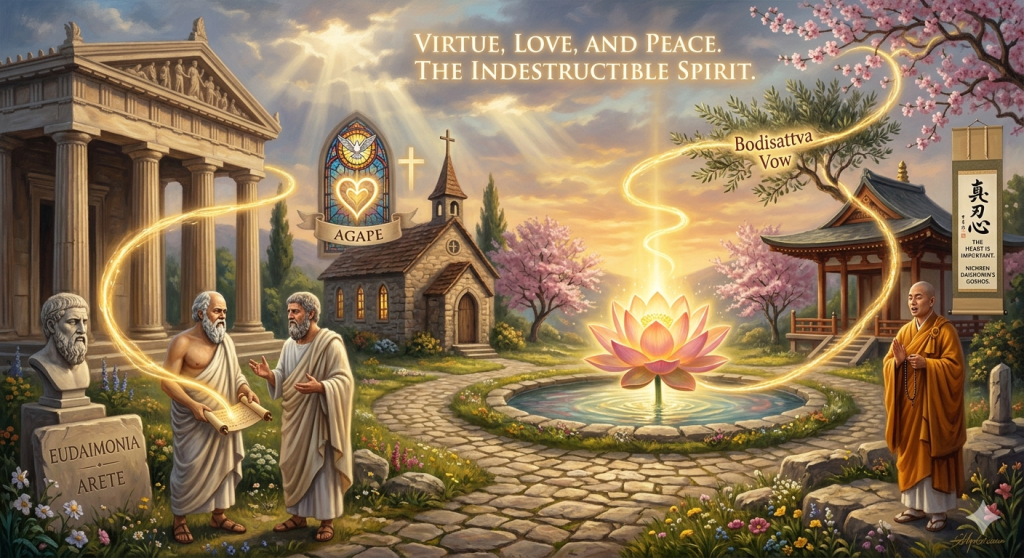
If we look closely at three seemingly distinct traditions—Nichiren Daishonin Buddhism, Christianity, and the Socratic/Platonic philosophy of ancient Greece—we find a profound, undeniable compatibility. Though separated by centuries, geography, and culture, these frameworks all orbit the same profound truths: the pursuit of the highest good, the transformative power of love, and the indestructible nature of the human spirit.
Let’s explore how these three pillars of human thought weave together a beautiful tapestry of virtue, love, and ultimate peace.
### *Eudaimonia*: The Shared Vision of Ultimate Happiness
To understand where these traditions intersect, we have to start with the end goal. What is the point of a well-lived life?
In Socratic and Platonic philosophy, the ultimate goal of human existence is **Eudaimonia**. Often translated simply as “happiness,” a much better translation is “human flourishing” or “the highest human good.” Plato argued that *Eudaimonia* isn’t a fleeting emotion; it is an objective state of being achieved only through the cultivation of **virtue** (*arete*).
Christianity offers a strikingly similar parallel. The “highest good” is Union with God and realizing the Kingdom of Heaven—which Christ famously stated is “within you.” True Christian flourishing is achieved not through worldly success, but by living a life of spiritual virtue and grace.
Nichiren Buddhism brings this concept directly down to earth through the concept of **Buddhahood**. In Nichiren’s teachings, Buddhahood is not a realm you travel to after death, nor is it reserved for a select few. It is an expansive, joyful, and unshakable state of life that exists within everyone right now. Like *Eudaimonia*, it is an absolute happiness that depends on your inner spiritual condition, not your external circumstances.
### The Action of Love and Virtue
How do we reach that state of flourishing? The consensus across the board is clear: through the active, outward practice of love and virtue.
* **Christianity and *Agape*:** The beating heart of the Christian gospel is *Agape*—unconditional, selfless love. It is a love that demands action, charity, and forgiveness. It’s not just a feeling, but a profound commitment to the well-being of others.
* **Plato and the Form of the Good:** For Plato, virtue is the alignment of the soul with the “Form of the Good.” Socrates taught that to know the good is to do the good. Virtue—whether it be courage, justice, or wisdom—is an act of love toward truth and harmony.
* **Nichiren Buddhism and the Bodhisattva Way:** In Nichiren Buddhism, virtue and love manifest as **compassion** (*jihi*). The core of the practice is the “Bodhisattva vow,” which is the commitment to not just seek enlightenment for oneself, but to actively work for the happiness and awakening of others.
In all three traditions, love is not passive. It is a muscular, active virtue that demands we step outside of our own egos and connect deeply with the humanity of others.
### The Spirit in Nichiren’s *Goshos*: A Bridge to the Divine
To truly understand this compatibility, we have to look at the nature of the human spirit. In his letters to his disciples, known as the *Goshos*, Nichiren Daishonin wrote extensively about the invisible, yet supreme, power of the mind and spirit.
> *”It is the heart that is important.”* — Nichiren Daishonin, *The Strategy of the Lotus Sutra*
>
Nichiren taught that a single moment of life contains the entire universe (a concept called *ichinen sanzen*). In his writings, he emphasizes that the human spirit is not a fragile, temporary thing, but an eternal entity endowed with ultimate dignity and power. He urged his followers to awaken to the reality that their lives were fundamentally indestructible and perfectly complete just as they are.
This view of the spirit harmonizes beautifully with the West:
1. **The Christian Soul:** Like Nichiren’s view of the infinitely dignified spirit, Christianity teaches that every soul is uniquely created in the *Imago Dei* (the image of God). The spirit is eternal, precious, and capable of overcoming darkness through faith.
2. **The Platonic Soul:** Plato believed the soul was immortal, existing before birth and surviving after death, constantly yearning to return to a state of perfect Truth and Beauty.
Whether we call it the Buddha nature, the immortal soul, or the divine spark, all three traditions validate that our core essence is sacred.
### The Ultimate Destination: Peace
When we synthesize Platonic *Eudaimonia*, Christian *Agape*, and the indomitable spirit of Nichiren Buddhism, what is the result? **Peace.**
* **Socratic Peace** is the inner harmony of a just soul, where reason, spirit, and appetite are perfectly balanced.
* **Christian Peace** is the “peace that passes all understanding,” a tranquility that comes from surrendering to God’s love.
* **Buddhist Peace** is the realization of *kosen-rufu*—a peaceful world created by individuals voluntarily awakening to their own inherent dignity and the dignity of all others.
These three great traditions serve as a powerful reminder: True peace isn’t simply the absence of conflict. It is the dynamic, living result of a spirit that is grounded in virtue, flourishing in *Eudaimonia*, and overflowing with love. No matter which vocabulary we use—East, West, or Antiquity—the path to a better world starts exactly in the same place: within our own hearts.


 A Personal ELENCHUS