Image Streaming: The Process and the Benefits
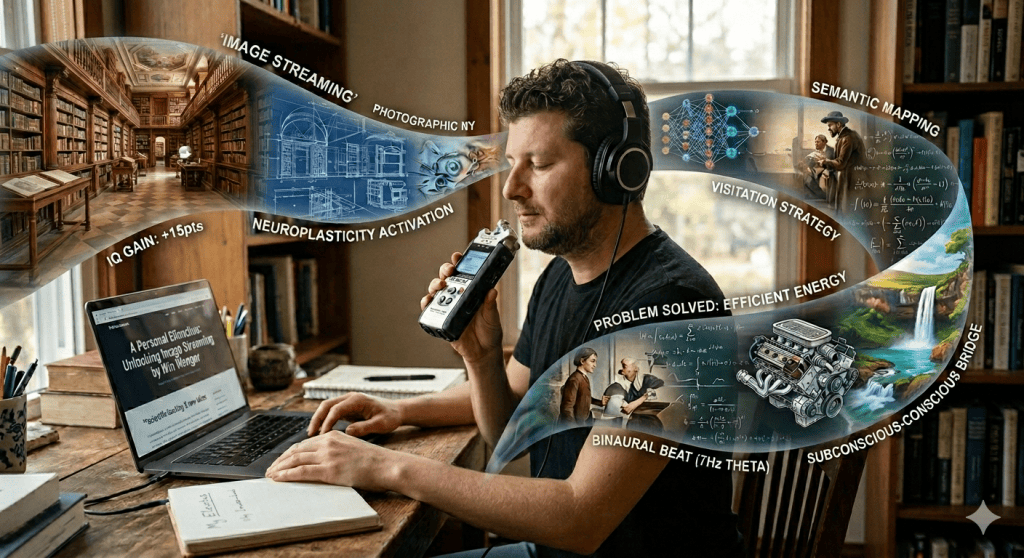
Welcome back to A Personal Ellenchus, where we continually question the boundaries of human potential and explore the mechanisms of the mind.
Today, we are diving into a cognitive tool that feels like a cheat code for the human brain: Image Streaming.
Pioneered in the 1970s by Dr. Win Wenger, a researcher and educator focused on accelerated learning, Image Streaming is a deceptively simple practice designed to bridge the gap between the conscious and subconscious mind. Wenger believed that by actively engaging with our mind’s eye, we could not only develop a photographic (or eidetic) memory, but also permanently increase our IQ and unlock entirely new dimensions of problem-solving.
Here is a breakdown of Wenger’s original method, the modern science that backs it up, and how we can adapt this practice for today.
The Core Process: How to Image Stream
At its heart, Image Streaming is about observing the spontaneous visual imagery that naturally occurs in your brain and forcing your language centers to process it.
Here is the traditional method:
- Find a quiet space: Sit comfortably, close your eyes, and relax.
- Look at the “screen” of your mind: Pay attention to the swirling colors, shapes, or spontaneous images that appear in your closed-eye vision (known as phosphenes or hypnagogic imagery).
- Describe it aloud in rapid-fire detail: This is the most critical step. You must speak aloud, to a voice recorder or a partner, describing the images using rich, sensory-specific language. Don’t just say, “I see a tree.” Say, “I see a massive, rough-barked oak with emerald green leaves shimmering against a violent violet sky; I can smell damp earth and hear the wind rattling the branches.”
- Keep the flow going: Do this continuously for 10 to 15 minutes.
Wenger argued that this rapid verbalization forces the brain to build new neural pathways between the visual, linguistic, and sensory regions.
Developing a “Photographic” Memory
True photographic memory is incredibly rare and mostly found in children, but Image Streaming trains the brain to simulate it.
Most of us have weak “mental muscles” when it comes to visualization. When we try to remember a scene, we remember the concept of it, rather than the vivid details. Image Streaming functions as a high-intensity workout for your visual cortex. By constantly demanding that your brain render high-fidelity imagery and translate it into speech, you train your mind to store waking memories with the same level of sensory richness. Over time, your recall transforms from vague, abstract concepts into sharp, replayable mental video.
The IQ Bump and the Science Behind It
Wenger famously claimed that practicing Image Streaming for just a few hours total could yield a measurable, permanent increase in IQ. While that sounds like late-night infomercial hyperbole, modern neuroscience offers compelling backing for why this practice makes us sharper.
- Hemispheric Synchronization: Image Streaming forces the right hemisphere (which generates spatial, abstract, and visual imagery) to communicate rapidly with the left hemisphere (which handles grammar, logic, and verbal articulation). This heavy cross-traffic strengthens the corpus callosum, the thick band of nerve fibers connecting the two halves of the brain. A thicker, more efficient corpus callosum is heavily correlated with high intelligence and creative genius.
- Activation of the Visual Cortex: Neuroimaging studies by researchers like Stephen Kosslyn have shown that vivid mental imagery activates the primary visual cortex (V1) in almost the exact same way that actual physical sight does. You are literally teaching your brain to “see” better from the inside out.
- Neuroplasticity and the DMN: The practice requires you to dip into the Default Mode Network (DMN)—the brain system active during daydreaming and ideation—while maintaining conscious, executive focus. This rare overlap fosters massive neuroplastic growth.
Problem Solving Through “Visitation”
One of the most profound benefits of Image Streaming is how it sets you up for advanced problem-solving through a concept we can call visitation.
When you become adept at Image Streaming, your mental landscape becomes a tangible place you can “visit.” Instead of trying to solve a complex engineering problem, an interpersonal conflict, or a creative block using linear, left-brain logic, you can construct the problem in your mind’s eye and step inside it.
This is how Nikola Tesla famously invented. He didn’t just draw blueprints; he “visited” his machines in his mind, turning them on, letting them run for weeks in his imagination, and visually inspecting them for wear and tear. By actively visiting your subconscious architecture, you allow your brain to run massive, parallel simulations that your conscious mind could never process linearly. You aren’t just thinking about a problem; you are walking around inside it.
New Takes: Modernizing the Stream
Wenger’s method is classic, but we can supercharge it using modern tools and new psychological frameworks:
- AI Synthesis: Instead of just recording your voice and never listening to it, transcribe your Image Streaming sessions using AI voice-to-text apps. You can then feed these transcripts into an LLM (like the one writing this!) and ask it to look for recurring archetypes, emotional patterns, or hidden solutions to problems you’ve been passively worried about.
- Binaural Beats & Flow Induction: Combine the practice with theta-wave binaural beats (around 4-7 Hz). This acoustic framing naturally induces the hypnagogic state where the most vivid imagery lives, allowing you to bypass the initial “warm-up” phase of the stream.
- Sensory Stacking: Modern practitioners are adding physical anchors to the practice. Holding a textured object or utilizing a specific scent (like peppermint or sandalwood) while streaming creates a multi-sensory anchor. Later, when you need to quickly recall a complex piece of information, smelling that same scent triggers the neural network you built during the stream.
If you are looking to pull more truth out of your own mind—in true Ellenchus fashion—Image Streaming is one of the most potent, zero-cost tools available. All it takes is a quiet room, a voice recorder, and the willingness to see what your mind is trying to show you.


 A Personal ELENCHUS