The Shadow and the Substance: Why Your Brain Can’t Tell the Difference Between Imagination and Reality
In the Socratic tradition, an elenchus is a tool for cross-examining beliefs to uncover a deeper truth. Today, let’s cross-examine one of the most stubborn assumptions of the modern secular mind: the belief that thoughts are “just thoughts” and have no tangible weight in the physical world.
For centuries, we’ve treated visualization as a pleasant, slightly woo-woo practice—a passive daydream. But cutting-edge neuroscience and ancient spiritual texts are converging on a startling truth. To your subconscious mind and your neural pathways, vividly imagining an action is virtually identical to physically performing it.
When you change your internal architecture, reality has no choice but to reflect the shift. Here is the cross-examination of the mind, backed by clinical labs and ancient scripture.
The Hard Science: What Happens in the Brain When You Visualize?
If you want to understand the subconscious, you have to look at neuroplasticity (the brain’s ability to physically rewire itself based on experience). Two landmark studies demonstrate that the mind does not need physical inputs to alter physical matter.
1. The Harvard Piano Study (Dr. Alvaro Pascual-Leone, 1995)
At Harvard Medical School, researchers split volunteers into groups to learn a short, five-finger piano exercise.
- Group A physically practiced the notes on a keyboard for two hours a day over five days.
- Group B sat in front of the keyboard but only imagined playing the notes, holding their hands completely still while visualizing the movements and the sounds.
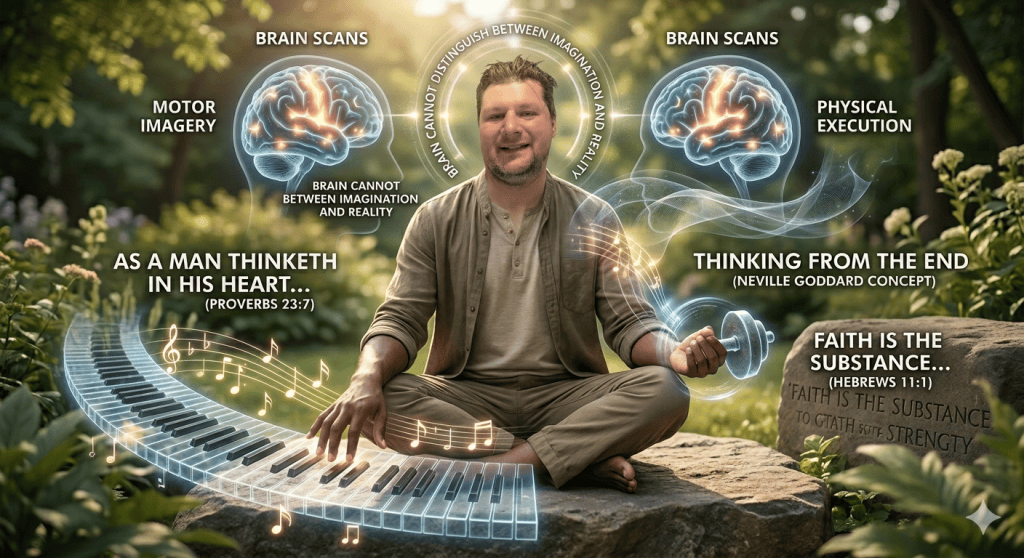
Using Transcranial Magnetic Stimulation (TMS) to map the brain, the results shocked the researchers. The region of the motor cortex responsible for controlling those fingers expanded dramatically in the physical players. But in the brains of the virtual players? The exact same neural expansion occurred. Their brains rewired themselves for a physical skill without their fingers ever pressing a key.
2. The Cleveland Clinic Muscle Study (Dr. Guang Yue, 2004)
Can thoughts build physical power? Dr. Guang Yue tested this by measuring muscle strength. He had one group physically exercise a finger muscle, while another group merely performed “mental contractions”—vividly imagining the maximum physical exertion of that muscle without moving a millimeter.
By the end of the study, the physical training group increased their muscle strength by 53%. Astonishingly, the purely mental group increased their physical strength by 35%. The physical muscles didn’t grow in size, but the mental training dramatically amplified the brain’s cortical output signal to the muscle, forcing it to fire at a higher, more efficient capacity.
What to look for in the visual above: Notice how the red highlights—representing neural activation in the primary motor cortex—light up in remarkably similar patterns during actual physical movement (top) and mental imagery (bottom). Your brain literally runs the execution program internally, whether your body moves or not.
The Biblical Confirmation: Murphy, Goddard, and the Psychological Drama
This biological reality is not a new discovery; it is an ancient one wrapped in a modern vocabulary. Twentieth-century mystics like Dr. Joseph Murphy (The Power of Your Subconscious Mind) and Neville Goddard pioneered the idea that the Bible is not a historical text, but a profound psychological manual detailing the mechanics of human consciousness.
When the Bible speaks of “faith,” it is describing the exact neurological mechanism mapped by Harvard and the Cleveland Clinic.“As a Man Thinketh in His Heart…”
One of the most famous psychological formulas in scripture comes from Proverbs 23:7:
“For as he thinketh in his heart, so is he.”In New Thought metaphysics, the “heart” never means the physical organ, nor does it mean fleeting intellectual thoughts. The “heart” represents the subconscious mind—the deep pool of emotionalized, core assumptions. What you repeatedly feed the subconscious via visualization becomes your hardwired identity.
Neville Goddard and “Thinking From the End”
Neville Goddard’s entire philosophy can be summarized by a single technique: living in the assumption that your desire is already fulfilled. He argued that the creative force of the universe is our own awareness, famously termed the inner “I AM.”
Neville pointed directly to Mark 11:24 as the ultimate manifestation formula:
“Therefore I tell you, whatever you ask for in prayer, believe that you have received it, and it will be yours.”Notice the tense of that verse. It doesn’t say believe you will receive it; it says believe that you have already received it. This is exactly what the virtual piano players did. They didn’t think about a future goal; they mentally occupied the state of executing the music in the present moment. Neville called this “feeling the wish fulfilled.” By doing so, you impress the subconscious mind, which then moves external reality to match the inner mold.
Joseph Murphy and the Language of the Subconscious
Dr. Joseph Murphy reconciled this with prayer. He explained that the subconscious mind accepts whatever is impressed upon it with high emotional conviction.
In Hebrews 11:1, scripture states:
“Now faith is the substance of things hoped for, the evidence of things not seen.”Murphy noted that your intense mental visualization is the substance. When you visualize with clarity and emotion, you are presenting your subconscious with “evidence of things not seen.” Because the subconscious cannot differentiate between a real event and a deeply felt imagination, it accepts the evidence as a present fact and begins filtering your perception, choices, and environment to make that inner reality manifest.
The Ultimate Elenchus
The cross-examination yields a definitive conclusion: the boundary between the “inner world” and the “outer world” is an illusion.
Science calls it neuroplasticity and cortical output. The Bible calls it faith and the Kingdom of Heaven within you (Luke 17:21). Both agree that your subconscious mind is a highly compliant engine. It does not argue; it simply takes the blueprints you give it through your imagination and builds them into your reality.
Stop daydreaming about what you want someday. Sit still, close your eyes, and experience it now. Your brain—and the universe—are listening.


 A Personal ELENCHUS