The Scribe’s Canvas: Memorizing Scripture and the Science of Rewriting
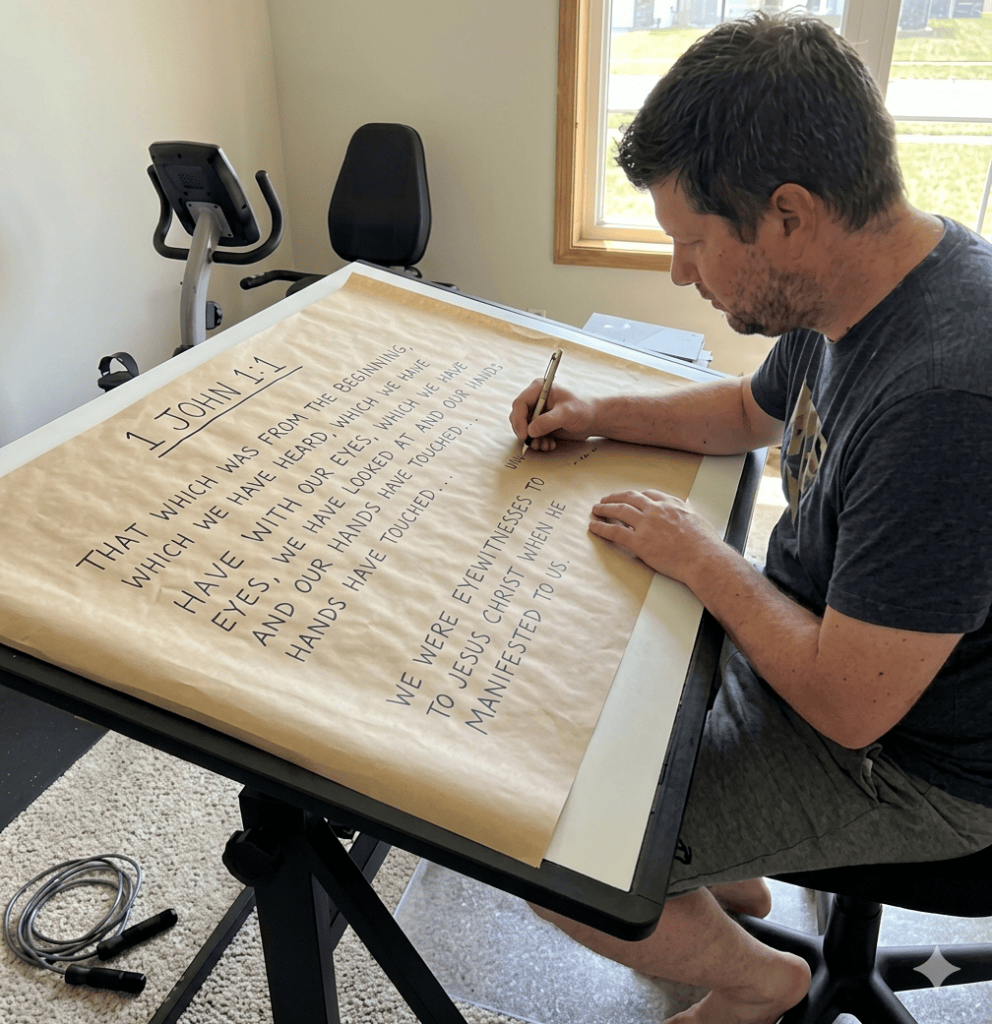
Welcome back to A Personal ELENCHUS. Lately, I’ve been undertaking a new mental and spiritual discipline: the memorization of Scripture.
I haven’t memorized a vast amount of it yet—this is very much a new beginning. But I firmly believe that the journey has to start somewhere, and the text I chose to begin with felt incredibly fitting. I started with the opening verses of 1 John. There is something profoundly striking about how this book opens. It isn’t just a theological statement; it is a raw, historical, eyewitness account of Jesus Christ made manifest to humanity.
“That which was from the beginning, which we have heard, which we have seen with our eyes, which we have looked at and our hands have touched—this we proclaim concerning the Word of life.” (1 John 1:1)
Notice the emphasis on the physical senses: hearing, seeing, touching. It’s a grounded, tactile reality. Ironically, that exact emphasis on the tactile is what led me to my chosen method of memorization.
The Old Scribe Method
When it comes to committing these verses to memory, I don’t use flashcards, apps, or rote verbal repetition. Instead, I use what I like to call the “old scribe method”—rewriting the text by hand.
But I don’t just use a standard notebook. I use a massive sheet of drafting paper (or sometimes heavy art paper). I lay it out and physically transcribe the text, carefully and repeatedly. Because the canvas is so large, the words don’t get lost in the flip of a page. You can actually see the entire progression of the text visually mapped out in front of you as you work through it.
It turns out that this ancient, physical approach to engaging with a text has some profound modern science backing it up.The Neurology of Handwriting
We live in an era of typing and swiping, but cognitive science shows that handwriting engages the brain in ways that keyboards simply cannot.
When you write by hand, you activate a specific neural circuit called the Reticular Activating System (RAS). The physical sensation of the pen dragging across the drafting paper, the fine motor control required to form the letters, and the visual feedback of seeing the word appear all work together to signal to your brain: “Pay attention. This matters.”
A recent study from Johns Hopkins University confirmed that the physical act of handwriting creates stronger, more robust neural pathways for memory and recall. By acting as a scribe, you aren’t just reading the words; you are physically building the architecture to house them in your mind.The Spatial Memory Advantage
This is where the massive sheet of drafting paper becomes a game-changer. Human memory is highly spatial. We evolved to remember where things are in our physical environment.
When you read a digital screen, the text scrolls, lacking a fixed physical location. But when you map out verses on a giant sheet of art paper, your brain encodes the physical geography of the words. When I try to recall 1 John 1:1, my mind’s eye doesn’t just search for the abstract words; it pictures exactly where my hand placed them on the top left corner of that massive canvas.The Therapeutic Power of the Pen
Beyond the cognitive benefits, there is a deep therapeutic value to the scribe method.
We live in a chronically overstimulated world. Sitting down in front of a large, blank sheet of paper with a single focus forces you to downshift. The rhythmic, repetitive motion of handwriting naturally slows your breathing and heart rate. It shifts the brain out of the anxious, fast-paced “fight or flight” mode (sympathetic nervous system) and engages the “rest and digest” mode (parasympathetic nervous system).
Rewriting Scripture becomes an active form of meditation. You aren’t rushing to the end of a chapter. You are forced to dwell on every single syllable. As I traced out the words “which we have seen with our eyes,” the slow pace of the pen allowed the gravity of that eyewitness claim to actually sink in.
I may be at the very beginning of this memorization journey, but the process itself is already proving to be a profound anchor. If you find yourself struggling to retain what you read, or simply looking for a way to quiet your mind, I highly recommend finding a big piece of paper, grabbing a pen, and returning to the ways of the scribe.


 A Personal ELENCHUS