Rename the Arenas: What Grand Rapids Teaches Its Children Every Time It Says a Name
A Personal Ellenchus — by Dr. Christopher Gerald Nylaan
The lesson in the letters
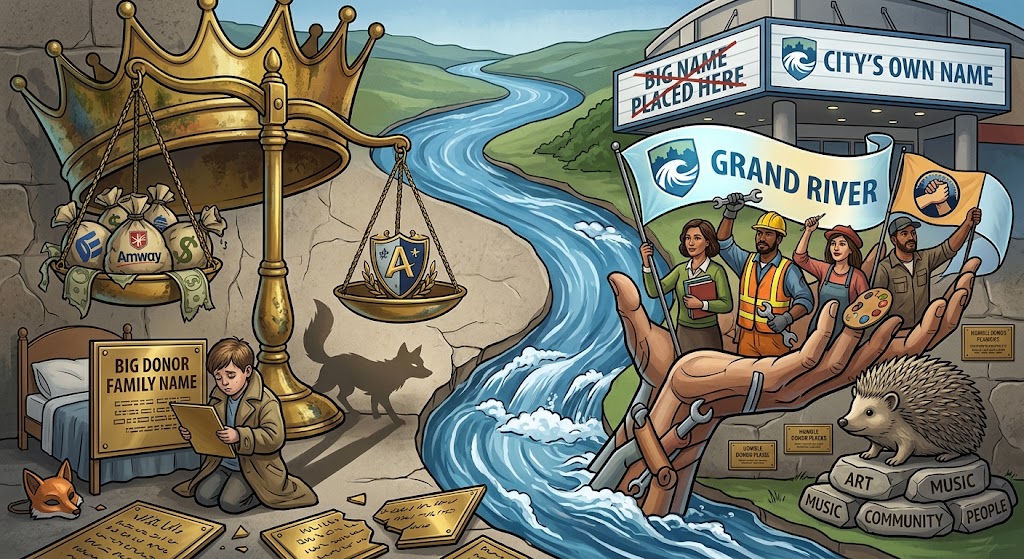
Take a child downtown. Walk west on Fulton and she will read one family’s name on the arena. Turn toward the river and she will read another family’s name on the convention center. Walk the Medical Mile and she will read a first name — Helen — above the beds of sick children. We tell ourselves this is gratitude. But children do not read plaques as gratitude. Children read plaques as instruction. What they learn is simple and it is corrosive: the city belongs to whoever wrote the biggest check.
The record is not hidden. Van Andel Arena “was named in recognition of the largest benefactors, Jay and Betty Van Andel” (Van Andel Arena). DeVos Place “is named for Richard DeVos, who donated $20 million towards its construction” (Wikipedia), a naming that followed a foundation pledge toward the private share of a $219.5 million public building (Crain’s Grand Rapids). And the pattern did not stop: Amway secured the naming rights to the new soccer stadium (WGVU). Three generations of civic architecture, one surname doing the talking.
Meanwhile the thing those buildings are for — the art, the music, the noise that makes a city worth visiting — was built by people whose names appear nowhere. Painters who slept on floors. Teachers who ran band programs out of closets. The volunteers and small donors who keep ArtPrize alive on ordinary gifts (ArtPrize). Capital took the credit and got the signage. Labor and imagination got the event listing.
The fox knows many things
Archilochus left us a line that Isaiah Berlin made famous: “The fox knows many things, but the hedgehog knows one big thing” (Isaiah Berlin, The Hedgehog and the Fox).
I am charmed that Vos is the fox. A fox knows many small things: how to structure a pledge, how to time an announcement, how to attach a family name to a bond issue, how to be photographed at a ribbon cutting. Those are real skills. They are also small skills.
The hedgehog knows one big thing, and the one big thing is this: a city is its people. Not its donors. Its people. Everything else is a footnote written in brass.
Would a rose by any other name
Shakespeare’s Juliet insisted the name is nothing — that a rose by any other name would smell as sweet. It is a beautiful line and it is wrong, and every advertiser, every politician, and every naming-rights lawyer on earth knows it is wrong. That is precisely why they pay for names. If names were nothing, nobody would spend eight figures to buy one. Ask yourself whether you would want a dozen roses delivered on Valentine’s Day if the flower had been given a cruder name. The scent would be identical. The gift would not be.
Names carry freight. Scripture treats naming as an act of authority and of blessing, which is exactly why naming a public square is never a neutral act of accounting.
One name, many names
And names are not fixed. Amway is a name; critics have long had other names for it, and the company has just agreed to pay $225 million to settle a lawsuit over alleged deception of the people who sold for it (Michigan Public). Amway is also, notably, not from here. Its world headquarters sits at 7575 Fulton Street East in Ada, roughly ten miles outside the city (Michigan Public). Grand Rapids is wearing another township’s jersey.
Let me be careful, because I mean to be fair. Van Andel and DeVos are not bad names. They are family names, borne by children and grandchildren who never asked to be civic wallpaper. Richard DeVos and Jay Van Andel built something enormous out of a Michigan basement, and the money they routed back into this city built real rooms where real people have been healed, married, and moved to tears by a symphony. I have love for the past. Genuine love.
I simply want to leave it there. In the past.
The stronger name
Consider the hospital. “Helen DeVos Children’s Hospital” is a 241-bed pediatric hospital on Michigan Street that ranks nationally (Wikipedia). Now say the alternative out loud: the Grand Rapids Hospital for Children.
Which one does a frightened parent from Muskegon trust more? Which one tells a nine-year-old in a gown that an entire city is behind her, rather than that one wealthy family was kind to her? The second name is not a demotion. It is an enlargement. It converts a gift into a covenant.
The same is true across the board:
- The Grand Rapids Arena — for the Griffins, the Gold, and everyone who has ever screamed themselves hoarse on Fulton.
- The Grand River Convention Center — named for the water and the rapids that gave the city its name in the first place.
- The Grand Rapids Stadium — where the name on the front of the shirt is the city, not a sponsor in Ada.
Or, if we must honor individuals, honor the ones who gave what they could not spare rather than what they would not miss: the teachers, the union organizers, the Black and Latino artists of the Southeast Side, the women who ran the arts councils on nothing.
End the king and queen
A republic does not keep a royal family. It does not put a dynasty’s surname on its public rooms and then wonder why its young people believe civic life is something purchased rather than something practiced. Philanthropy deserves thanks — a portrait, a plaque, a named scholarship, a foundation that carries the family name proudly. It does not deserve the city’s own mouth.
So here is the proposal, plainly. Let the city council and the Convention and Arena Authority open a public, deliberative renaming process for our civic venues, with hearings in every ward and a binding advisory vote. Let the donor plaques stay — larger, even, and more honest about the history. But let the marquee read the city’s name.
I have love for the past. Let’s leave it there.
Grand Rapids is back. End the king and queen. Let’s rename the arenas.
— Dr. Christopher Gerald Nylaan, A Personal Ellenchus


 A Personal ELENCHUS