The Wrong Drug for a Bruised Brain

A Personal Ellenchus — apersonalellenchus.blog
I should say at the outset what this post is not. It is not medical advice. I am not a physician, and the drug I am about to speak well of is still a Schedule I substance in the United States, which means that as of this writing the law regards it as having no accepted medical use at all. If you are reading this because you or someone you love is struggling after a concussion, please take it as an argument to think about, not a prescription to act on.
What it is, instead, is an attempt to cross-examine a habit. When a brain injury leaves someone agitated, frightened, sleepless, and not themselves, medicine has a reflex. The reflex is to reach for something that sedates. For a long time that something has been haloperidol, sold as Haldol — a sixty-year-old antipsychotic that quiets a person quickly and asks no questions. I want to ask the questions it doesn’t.
What post-concussion syndrome actually is
Start with the thing itself, because it is widely misunderstood, including by people who have it.
The textbook version of a concussion is that you get hit, you feel awful for a week or so, and then you are fine. For most people that’s true. But the newer, larger studies have dismantled the comforting part of that story. The TRACK-TBI research found functional impairment in up to a third of mild brain injury patients at three months and in roughly one in five at a full year, and a conservative estimate is that ten to fifteen percent of the tens of millions of concussions sustained worldwide each year turn into something prolonged (Prolonged Postconcussive Symptoms, PMC). That is hundreds of thousands of new people every year who did not get the week-and-done version.
And what they got is strange. Headache and dizziness, yes, but also a kind of emotional weather that doesn’t match the day: irritability that arrives without a trigger, anxiety that won’t be reasoned with, sleep that fragments, a fog that makes reading a page feel like lifting something heavy. Contemporary research has come to see this as multi-causal — not just the bruise, but coping style, mood and anxiety disorders, neck injury, and sleep disturbance all feeding one another (Prolonged Postconcussive Symptoms, PMC). The clinical literature now leans on biopsychosocial models precisely because a purely mechanical account of the injury cannot explain why some people recover and others do not (Journal of Neurotrauma review).
Hold on to that. The thing that persists is not mostly the impact. It is what the impact set in motion — a nervous system that learned, in the space of a few seconds, that the world is dangerous and the body cannot be trusted, and then kept behaving accordingly long after the tissue healed.
If that description sounds familiar, it should. It is very nearly the description of post-traumatic stress.
The Haldol reflex
Now the drug that gets reached for.
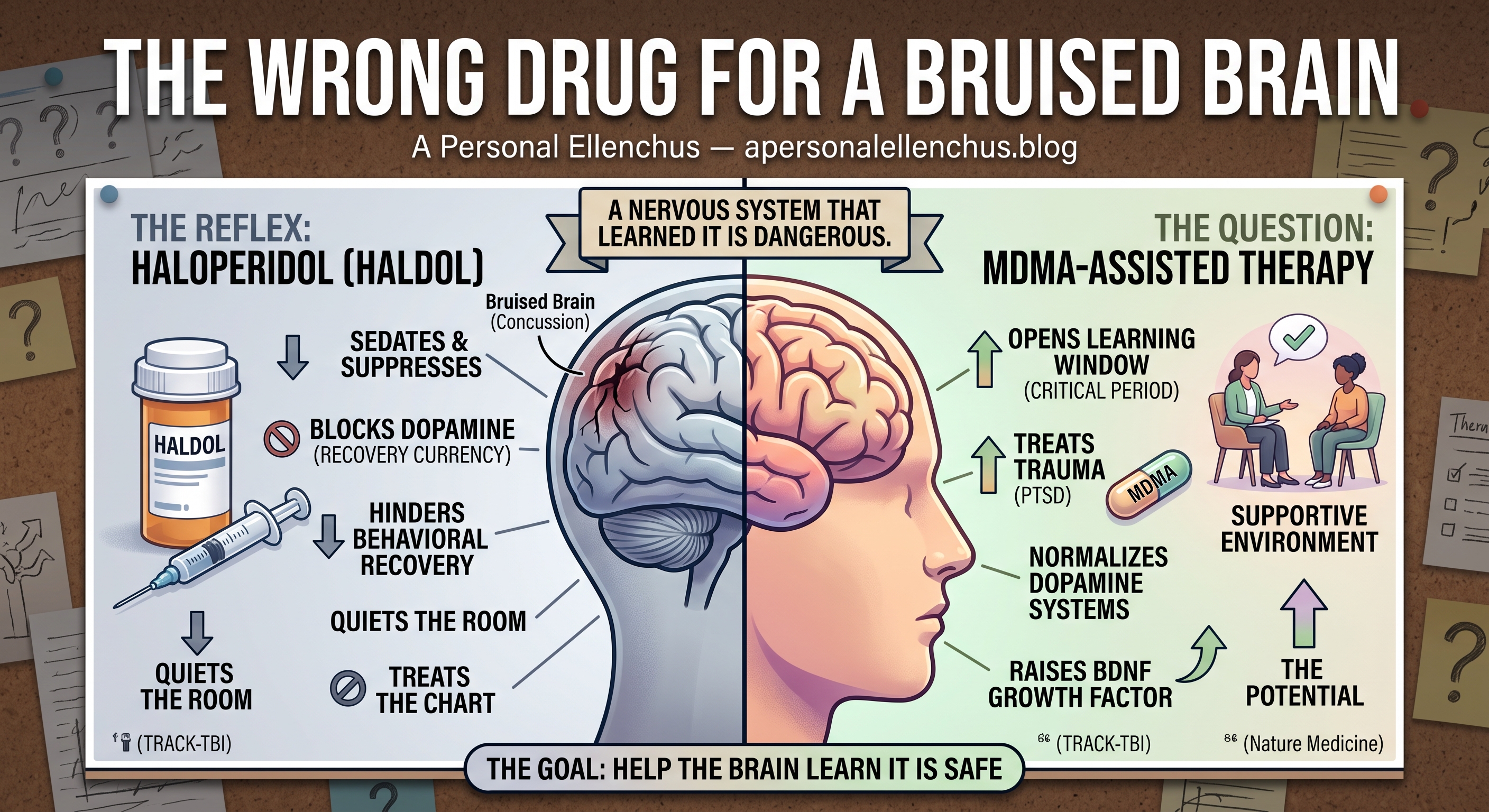
Haloperidol works by blocking dopamine. That is the whole mechanism, and it is also the whole problem. Dopamine is not incidental to a recovering brain; it is one of the currencies it uses to relearn. The animal research on this point is not ambiguous. Rats given haloperidol after an experimental brain injury show impaired cognitive performance compared to injured rats given other drugs or nothing (American Journal of Physical Medicine & Rehabilitation). Chronic dosing with haloperidol and risperidone hinders behavioral recovery after cortical impact in ways that persist (Neuroscience Letters), and a 2015 study in the Journal of Neurotrauma summarizes the field bluntly: experimental TBI studies consistently show that daily haloperidol hinders recovery (Journal of Neurotrauma).
This isn’t only lab-rat knowledge. A 2021 systematic review of systematic reviews — the highest tier of evidence-gathering there is — looked at every class of drug used for agitation and aggression after brain injury and concluded with a recommendation to avoid haloperidol and benzodiazepines in that setting (Journal of Head Trauma Rehabilitation). Rehabilitation guidelines now repeat that recommendation (KITE Brain Injury Guidelines), and trauma protocols at major hospitals instruct clinicians to avoid large doses of haloperidol in brain-injured patients (Vanderbilt delirium guideline).
So why is it still given? I think the honest answer is that Haldol solves the problem the room has, not the problem the patient has. An agitated person is disruptive, frightening to staff, hard to manage. A sedated person is none of those things. The drug makes the symptom disappear from view, and in doing so it makes the recovery harder — a trade the patient did not agree to and usually doesn’t know was made.
There is an old phrase for this: treating the chart. I don’t say it to indict anyone. Emergency medicine is practiced under conditions I would not last an hour in. But a reflex is worth examining precisely when it is universal and unquestioned.
Why MDMA, of all things
Here is where a reasonable reader raises an eyebrow, and I don’t blame them. MDMA is a party drug. It has the cultural residue of warehouse raves and pacifiers and a certain era of moral panic. Putting it in the same sentence as brain injury sounds like a provocation.
But strip away the residue and look at what the molecule actually does, and the case builds itself.
First, the clinical evidence for MDMA-assisted therapy in trauma is real and unusually strong. In the second of two Phase 3 trials published in Nature Medicine, 71 percent of participants who received MDMA alongside therapy no longer met the criteria for PTSD at the end of the study, against 48 percent in the group that received therapy with a placebo, and only one of 53 MDMA participants dropped out compared with eight of 51 in the placebo arm (Nature Medicine, 2023). The earlier Phase 3 trial, run in partnership with the FDA under a Breakthrough Therapy designation, showed the same pattern in people with severe PTSD (Nature Medicine, 2021).
Second — and this is the part that matters for a bruised brain specifically — MDMA does something haloperidol does the opposite of. It appears to open a window for relearning. Researchers at Johns Hopkins found that MDMA reopens a “critical period” in the adult brain, a developmental window normally closed after adolescence, during which the brain becomes newly sensitive to learning from its social environment; the effect lasted at least two weeks after a single dose, and crucially, it only opened when the animals were with others, not alone (Johns Hopkins Medicine). Haloperidol slams the dopamine system shut. MDMA, in the right context, seems to prop a door open.
Third, there is a small, odd, and to me fascinating piece of direct evidence. A 2014 study in mice subjected to minimal traumatic brain injury found that low-dose MDMA normalized the dopamine-system disruptions the injury caused — tyrosine hydroxylase and D2 receptor levels — and raised BDNF, a growth factor the brain uses for repair. And then the detail that made me sit up: the protective effect of MDMA was reversed by haloperidol (Journal of Molecular Neuroscience). In one experiment, the two drugs I am contrasting in this post were literally placed in opposition, and the one we hand out in emergency rooms undid what the one we criminalize had done.
Fourth, people who study brain injury for a living have started saying this out loud. A 2024 review in NeuroRehabilitation argued that MDMA-assisted therapy could be integrated into neurorehabilitation for service members with neurological injuries, on the grounds that it addresses the emotional and cognitive barriers that so often stall physical recovery, and that its capacity to increase plasticity could support the relearning of lost function (NeuroRehabilitation, PMC). That is not a blog post. That is a peer-reviewed rehabilitation journal.
The honest difficulty
A blog named after the Socratic method is obligated to turn the questions on itself, so let me.
The direct evidence that MDMA treats post-concussion syndrome in humans does not exist. There has been no randomized trial. What exists is a strong trial record in PTSD, a compelling mechanism, an animal study, and a review by clinicians who think it’s worth pursuing. That is an argument by analogy and inference, and analogies have a way of breaking at exactly the point where you most need them to hold. The overlap between persistent post-concussion symptoms and trauma is real, but overlap is not identity. A concussed brain may have vulnerabilities — to cardiovascular strain, to seizure threshold, to overheating — that a PTSD patient’s does not, and MDMA is not a gentle drug on the body.
The regulatory history should also give pause. The FDA declined to approve MDMA-assisted therapy for PTSD in August 2024, citing concerns about the durability of the response, the completeness of the safety data, and the potential for bias in trials where most participants could guess what they’d been given (HCPLive). The application has since been resubmitted by the sponsor, now called Resilient Pharmaceuticals, and is under reconsideration as of this summer (HCPLive). I would be lying if I said the agency’s concerns were baseless. A therapy where you can usually tell whether you got the drug is a hard therapy to test cleanly. That doesn’t mean it doesn’t work. It means we know less than the enthusiasts claim.
And there is a version of this argument I want to disown. It’s the one where a substance becomes a cause, where the case for a drug turns into a case for a subculture, and the patient gets lost behind the flag. I am not interested in that. I am interested in the person in the bed.
What I actually think
Here is where I land, holding all of that.
The question is not “is MDMA proven for post-concussion syndrome?” It isn’t, and anyone who tells you otherwise is selling something. The question is: given what we know, which direction is the evidence pointing, and which direction are we walking?
The evidence says haloperidol impairs a recovering brain. It says so in animals, repeatedly, and it says so in the systematic reviews that guide rehabilitation practice. We keep using it anyway, largely because it is old, cheap, and quiets the room.
The evidence says MDMA, given with therapy and in a supportive setting, produces durable relief in trauma at rates other treatments don’t approach, and that it does so partly by reopening the brain’s capacity to relearn — the precise capacity a concussion injures and haloperidol suppresses. We keep it in Schedule I anyway, largely because of what it used to mean at a party thirty years ago.
That is a strange pair of decisions to defend together. One drug is used despite the evidence and the other is forbidden despite it. If I were designing a system from scratch, I would not arrive at that arrangement, and I suspect no one else would either. It exists because it accumulated, not because it was chosen.
I don’t know that MDMA is the answer to post-concussion syndrome. I do know that the drug we reach for reflexively is, on the evidence we have, closer to the wrong one — and that the drug we refuse to study is the one whose mechanism actually matches the injury. At the very least, that inversion deserves a trial. It deserves more than a reflex.
The Ellenchus, as always, ends where it should: not with certainty, but with a better question than the one we started with. The old question was how to quiet a brain that is frightened. The better one is how to help it learn that it is safe.
— Christopher, Detroit


 A Personal ELENCHUS