Vraylar: The Ultimate Modulator
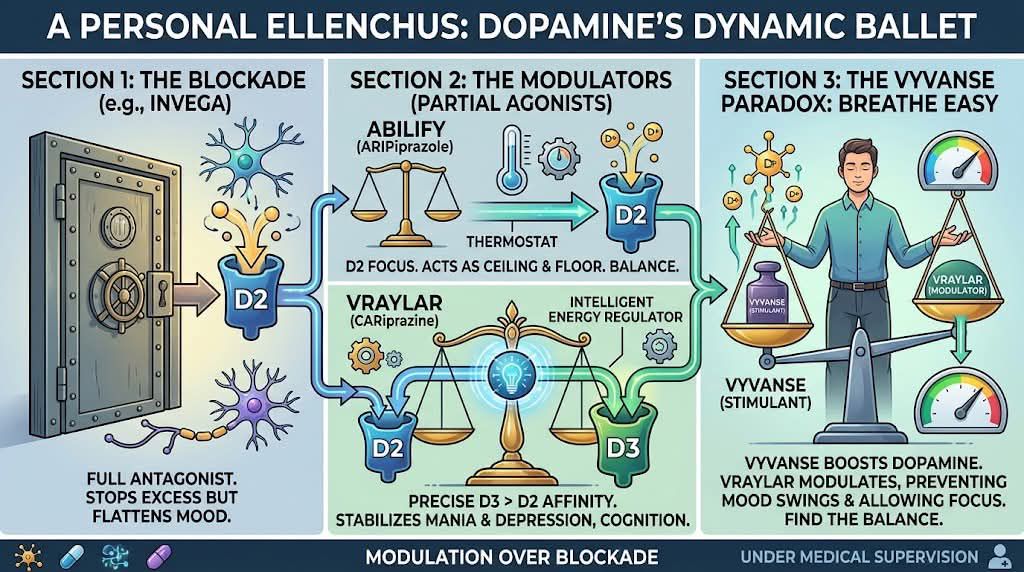
Welcome to another entry of my personal elenchus—a space where we cross-examine the standard narratives of mental health and neurochemistry to find a deeper truth.
Today, we’re putting dopamine on the stand.
For decades, the psychiatric approach to conditions like schizophrenia, bipolar mania, and treatment-resistant depression was fairly blunt: if dopamine is too high, build a wall and block it. But the brain is a delicate ecosystem. When you introduce a complex variable—like needing a stimulant such as Vyvanse for ADHD—that “wall” suddenly becomes a massive problem.
To understand how to safely walk this tightrope, we need to look at the intricate evolution of antipsychotics. We are moving from the era of the **blockade** to the era of the **modulator**, and at the bleeding edge of that shift is Vraylar.
—
## The Blockade: Invega (Paliperidone)
Let’s start with the older generation of atypical antipsychotics, like Invega.
Pharmacologically, Invega is a dopamine D2 antagonist. In plain English: it is a blockade. It finds the dopamine receptors in your brain and parks itself there, preventing your natural dopamine from binding.
When your brain is experiencing a dopamine storm (which can manifest as mania or psychosis), Invega acts as a highly effective dam, stopping the flood. But what happens when the storm passes? The dam is still there. This strict blockade is why many people on heavy antagonists report feeling “flat,” unmotivated, or chronically fatigued. The medication doesn’t know the difference between the dopamine that causes hallucinations and the dopamine that helps you enjoy a cup of coffee.
## The First-Gen Modulator: Abilify (Aripiprazole)
Enter Abilify. When it hit the market, it was a revelation because it wasn’t just a dam—it was a thermostat.
Abilify is a **partial agonist** at the D2 receptor. Instead of just blocking the receptor completely, it binds to it and activates it *partially*. If your natural dopamine is too high, Abilify competes for the receptors and lowers the overall activity (acting like an antagonist). If your natural dopamine is too low, Abilify stimulates the receptors just enough to keep the lights on (acting like an agonist).
It’s a brilliant mechanism, but it’s still relatively broad, focusing heavily on those D2 receptors.
## The Ultimate Modulator: Vraylar (Cariprazine)
If Abilify is a standard thermostat, Vraylar is a smart-home climate control system.
Vraylar is also a partial agonist, but its receptor profile is beautifully intricate. While it modulates D2 receptors, it has an affinity for **D3 receptors** that is nearly ten times higher than its affinity for D2.
Why does this matter? D3 receptors are highly localized in the parts of the brain responsible for mood, cognition, and the reward pathway. By gently modulating D3 rather than just hammering D2, Vraylar is incredibly effective at treating the *depressive* and cognitive symptoms of bipolar disorder and schizophrenia, not just the manic ones. It doesn’t just stop the highs; it actively supports the lows. It’s the ultimate biological buffer.
Before we talk about stimulants, play around with this visualization to actually *feel* how this biological buffer works compared to a strict blockade:
—
## The Vyvanse Paradox: Breathing Easy
Now we arrive at the ultimate pharmacological paradox. What if you have ADHD and bipolar disorder? What if you need a stimulant like Vyvanse (which forces your brain to release more dopamine) to focus, but you also need an antipsychotic to keep your mood stable?
If you mix Vyvanse with a blockade like Invega, you are essentially driving a car with the parking brake fully engaged. The Vyvanse tries to push dopamine into the synapse, and the Invega stubbornly blocks it. Best case scenario: the Vyvanse doesn’t work. Worst case scenario: you experience severe cardiovascular strain or a chaotic mood response.
This is where Vraylar’s “ultimate modulation” earns its crown. While there are generally no strict pharmacological contraindications between Vraylar and Vyvanse, combining them requires a masterful touch.
Because Vraylar is a partial agonist, it allows you to **breathe easy**. It acts as a safety net. When you take Vyvanse, the stimulant boosts your dopamine to help you focus. Instead of hitting a brick wall, that dopamine hits Vraylar’s smart-buffer. If the Vyvanse pushes the dopamine levels too high—flirting with the threshold of mania or anxiety—Vraylar’s partial agonism kicks into “antagonist mode,” capping the excess and protecting your stability. But because it’s a modulator, it still allows enough of the Vyvanse-induced dopamine through to let you concentrate, read, and live your life.
It’s the difference between locking a door and putting a bouncer at the velvet rope.
*Disclaimer: This is a personal elenchus and exploration of neurochemistry, not medical advice. Always work closely with a psychiatrist when combining stimulants and antipsychotics…


 A Personal ELENCHUS