The Pauline Rebuttal: Grace, Law, and the Suffering Servant
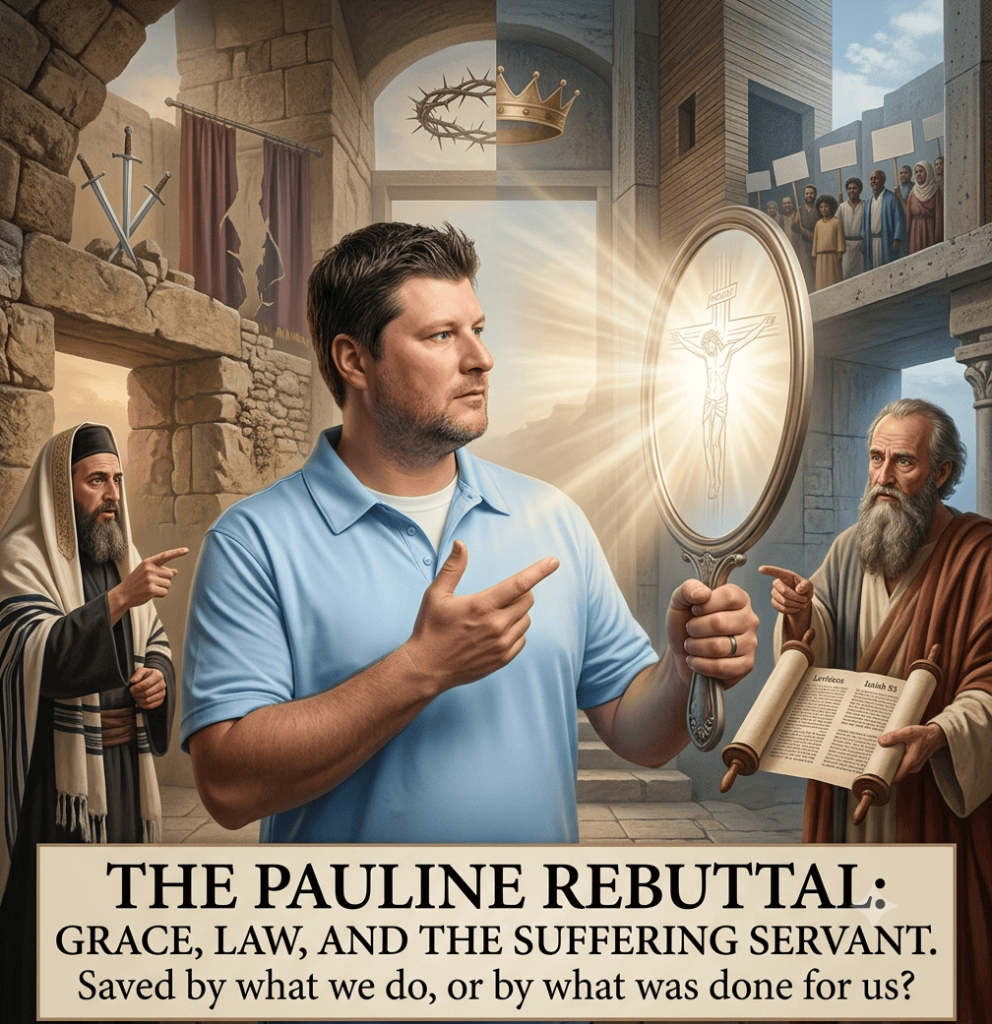
Paul, a servant of Christ Jesus, called to be an apostle, set apart for the gospel of God—to Christopher:
Grace to you and peace from God our Father and the Lord Jesus Christ.
I rejoice in your pursuit of truth, Christopher, and I understand the deep wrestling of your spirit. The arguments you have encountered from our Jewish brethren are not new to me; they are the very convictions I once breathed as a Pharisee of Pharisees, taught at the feet of Gamaliel, zealous for the traditions of our ancestors.
Yet, what was once gain to me, I now consider loss for the surpassing worth of knowing Christ Jesus my Lord. You have been told that Christianity relies on a false reading of Scripture, that Jesus failed to fulfill the prophecies, and that the heavy yoke of the law—what they call orthopraxy—is the true path to God.
I write to you now to explain the mystery of the gospel, to show you why the veil remains over their hearts when the old covenant is read, and why Jesus of Nazareth is indeed the Christ, the eternal Son of the Living God.
1. The Purpose of the Law and the Need for a Savior
You were told that a man needs no intermediary and that God desires us to simply keep the commandments to repair the world. But I ask you, Christopher: who has kept them?
The law is holy, righteous, and good, but it has no power to save. Its true purpose was to act as a mirror, exposing our deep, inherent brokenness, and as a guardian to lead us to Christ. If righteousness could be obtained through our own actions and obedience to the 613 commandments, then Christ died for nothing. We are not justified by works of the law, because by the works of the law no human being will be justified in God’s sight. We are all under sin.
They claim no blood sacrifice is necessary, only teshuvah (repentance). Yet the Torah they revere explicitly establishes the sacrificial system. The book of Leviticus declares, “For the life of a creature is in the blood, and I have given it to you to make atonement for yourselves on the altar.” When the Temple was destroyed, they replaced the blood of the lamb with the words of their lips. But God did not change His standard of justice; He provided the ultimate, perfect Lamb. Jesus is the fulfillment of the sacrificial system. He is our great High Priest, the one mediator between God and mankind.
2. The Prophecies Fulfilled: The Suffering Servant
Our brethren argue that Jesus did not fulfill the Messianic prophecies because He did not immediately bring about global political peace or rebuild a temple of stone. They read the prophets looking only for a conquering king, and in doing so, they miss the weeping prophet and the suffering servant.
Before the Messiah could wear the crown of glory, He had to wear the crown of thorns. How do they read Isaiah 53, which speaks of a man who was “pierced for our transgressions, crushed for our iniquities” and by whose wounds “we are healed”? How do they read Psalm 22, where the psalmist cries out, “They have pierced my hands and my feet”?
They expect the Messiah to conquer Rome or modern empires, but Christ came to conquer far greater enemies: sin, death, and separation from God. The peace He brought in His first coming was the ultimate peace—reconciliation between a holy God and fallen humanity.
As for the Temple? He did rebuild it. Not with stones that can be torn down by Roman legions, but by raising His own body from the grave. Now, through the Holy Spirit, we are the living stones of the new Temple. The ingathering of the exiles has begun, expanding beyond the physical borders of Israel to draw people of every tribe and tongue into the family of God. The physical realities they demand—the swords beaten into plowshares—will indeed be consummated upon His return, but the foundation has already been laid.
3. The Mystery of the Incarnation: Why the Messiah is God
The most profound stumbling block for my Jewish brethren is the claim that God became flesh. They hold fiercely to the Shema—”The Lord our God, the Lord is One”—and rightfully so. We do not worship three gods, Christopher; we worship the One True God who has revealed Himself in three persons.
They insist the Messiah is merely a man, a descendant of David. But a mere man, born in sin, cannot bear the infinite weight of the sins of the world. Only God Himself is entirely sinless. Only an infinite God can offer an infinite sacrifice.
Consider the prophet Micah, who predicted the Messiah would be born in Bethlehem. He wrote that this ruler’s origins are “from of old, from ancient times” (Micah 5:2). Consider Isaiah, who prophesied that a child would be born and called “Wonderful Counselor, Mighty God, Everlasting Father, Prince of Peace” (Isaiah 9:6). How can a mere earthly king be called “Mighty God”?
Christ Jesus, being in very nature God, did not consider equality with God something to be used to his own advantage; rather, he made himself nothing by taking the very nature of a servant, being made in human likeness. He became the bridge across the chasm we could never cross ourselves.
Do not be unsettled by their arguments, Christopher. The beauty of the gospel is not that it abandons the Hebrew Scriptures, but that it fulfills them. The story of Israel—the Exodus, the Passover, the Law, the Prophets—is the shadow of the things that were to come. The reality, however, is found in Christ.
Hold fast to grace. Do not let anyone submit you again to a yoke of slavery under a law that can only condemn. Your salvation does not depend on the perfection of your actions, but on the finished work of the Savior on the cross.
The grace of our Lord Jesus Christ be with your spirit.
**Draft for A Personal ELENCHUS (CNYLAAN.WORDPRESS.COM)**
# The Pauline Rebuttal: Grace, Law, and the Suffering Servant
In my last post, I explored the Jewish perspective on faith, an intricate worldview built on radical personal accountability, orthopraxy, and the sacred act of wrestling with God. But the Socratic method—the very essence of an *elenchus*—demands that we cross-examine every argument. We must interrogate the thesis to find the truth in the friction.
If the Jewish paradigm offers a compelling thesis of human action and unmediated repentance, what is the Christian antithesis? To dig into this, I shifted my focus to the theology of the Apostle Paul—the brilliant Pharisee who stepped across the ultimate theological divide to champion the Gospel.
When you place Paul’s arguments directly against the Jewish scholarly view, the contrast is staggering. Here is how the Christian worldview answers the Jewish critique:
### The Law as a Mirror, Not a Ladder
Judaism views the Torah and its 613 commandments as the very mechanism for sanctifying the world—a heavy but beautiful yoke of responsibility. Paul flips this entirely on its head. He argues that while the Law is holy and good, it possesses absolutely no power to save us.
Instead, Paul views the Law as a mirror designed to expose our deep, inherent brokenness. If perfect obedience is the standard, humanity will inevitably, universally fall short. In the Pauline view, the Law was never meant to be a ladder we climb to reach the Divine; it was a guardian meant to show us that we are utterly incapable of saving ourselves. Where human effort and orthopraxy fail, grace steps in through the finished work of a Savior.
### Two Visions of the Messiah
Perhaps the most fascinating part of this theological dialectic is how both traditions read the exact same Hebrew prophets but arrive at wildly different destinations.
The Jewish expectation is a conquering king—a descendant of David who brings immediate global peace and rebuilds a physical Temple of stone. Paul counters this by pointing to a different thread woven through the prophets: the “Suffering Servant” of Isaiah 53 and the agonizing cries of Psalm 22.
From the Christian perspective, the Messiah couldn’t just conquer Rome; He had to conquer humanity’s greatest existential enemies: sin, death, and separation from God. The crown of thorns had to precede the crown of glory. As for the Temple? Paul argues it *was* rebuilt—not with mortar, but through the resurrection, transforming believers themselves into the living stones of a new, spiritual sanctuary.
### The Necessity of the Infinite
The ultimate dividing line between the two faiths is the Incarnation. To the Jewish mind, God becoming a man is an impossible crossing of boundaries, a violation of the absolute oneness of the Creator.
Paul doesn’t abandon the oneness of God, but he introduces a profound mystery. He argues that a mere mortal man, born into a flawed world, is fundamentally incapable of bearing the infinite weight of cosmic redemption. Only God Himself is sinless. Therefore, only God Himself, stepping down into the dust and messiness of human flesh, could offer an infinite sacrifice to bridge the chasm.
### The Verdict of the Elenchus
Sitting with these two perspectives is a heavy intellectual and spiritual exercise. On one hand, you have the rigorous, action-oriented, unmediated responsibility of the Jewish covenant. On the other, you have the profound, unmerited grace of the Christian Gospel, where the heavy lifting has already been done on a cross.
This is the heart of the Elenchus: refusing to settle for unexamined beliefs. By holding these opposing theological titans to the light, the friction between them forces us to ask the most important question of all: Are we saved by what we do, or by what was done for us?


 A Personal ELENCHUS