The Pilgrim’s Progress: Walking the Path
Welcome back to A Personal ELENCHUS.
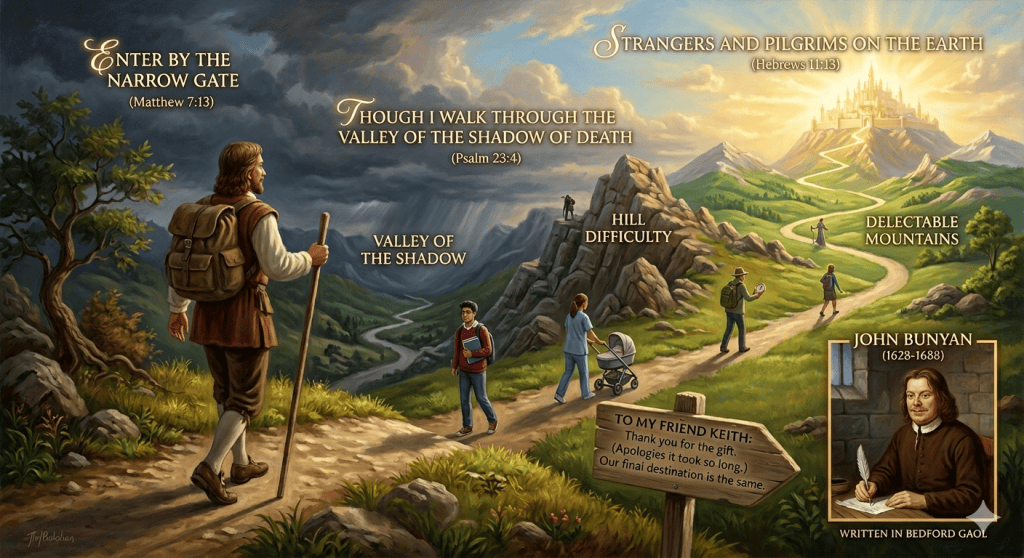
Before I get into the meat of this reflection, I need to send a massive thank you to my friend Keith for gifting me a copy of The Pilgrim’s Progress. Keith, my sincere apologies that it took me so long to finally sit down and read it. Looking back, though, the timing feels entirely providential. I read it exactly when I needed to.
Forged in the Fire
To really understand The Pilgrim’s Progress, you have to understand where John Bunyan was when he wrote it. He didn’t draft this masterpiece from a comfortable study; he wrote it from a cell in the Bedford County Gaol in 1678.
A tinker by trade and a Puritan preacher by calling, Bunyan was imprisoned for 12 years simply for refusing to stop preaching outside the established Church of England. He sacrificed his freedom to preserve his conscience. Out of that profound isolation came the story of Christian—a man carrying a massive, crushing burden on his back, fleeing the City of Destruction to find the Celestial City. The allegory is raw, resonant, and enduring because it was hammered out in the fires of actual suffering.
The Word as a Map
Bunyan’s work is essentially the Bible brought to life in a literal landscape. Every step Christian takes is grounded in scripture, mapping out the geography of the believer’s soul:
- The Wicket Gate: The journey begins exactly where Christ said it must. “Enter by the narrow gate. For the gate is wide and the way is easy that leads to destruction…” (Matthew 7:13).
- The Valley of the Shadow of Death: Bunyan doesn’t shy away from the darkest parts of the human experience. Echoing Psalm 23:4, it’s a stark reminder that the walk isn’t about detouring around the darkness, but walking straight through it with faith.
- The Pilgrim Mindset: The core theme of the book rests on Hebrews 11:13, reminding us that we are “strangers and pilgrims on the earth,” seeking a homeland we have not yet seen.
Synchronicities and Cross-Examinations
Reading this, I couldn’t ignore the deep synchronicities with my own life. The whole premise of an Elenchus is a relentless cross-examination to find the truth—stripping away the falsehoods, the comfortable lies, and the easy excuses. That is exactly what Christian is forced to do on his journey.
When I look at my own path—studying the complexities of law, stepping into the trenches of peer support and advocacy, and managing the intense, daily realities of caregiving—I recognize Bunyan’s terrain instantly. I’ve been stuck in the Slough of Despond. I’ve felt the crushing weight of the burden on my back when trying to navigate broken systems or simply trying to be a solid anchor for the people under my roof. I’ve met my share of “Mr. Worldly Wiseman” types, people who offer logical, easy ways out that completely miss the ultimate truth.
But that is the beautiful, brutal reality of this book. Everyone trying to walk with Christ fights similar battles. We all face our own versions of Apollyon in the valley. We all have to grind our way up the Hill Difficulty. But we also get to reach similar pinnacles—those rare, breathtaking moments of clarity and grace on the Delectable Mountains where we can actually see the destination ahead.
Our individual paths, our specific burdens, and the people we are called to serve along the way might look different. But the struggles are shared, the grace is the same, and our final destination is exactly the same.
Keep walking the path.


 A Personal ELENCHUS