The Healing Power of Being Wrong: Why I Practice a “Personal Elenchus”
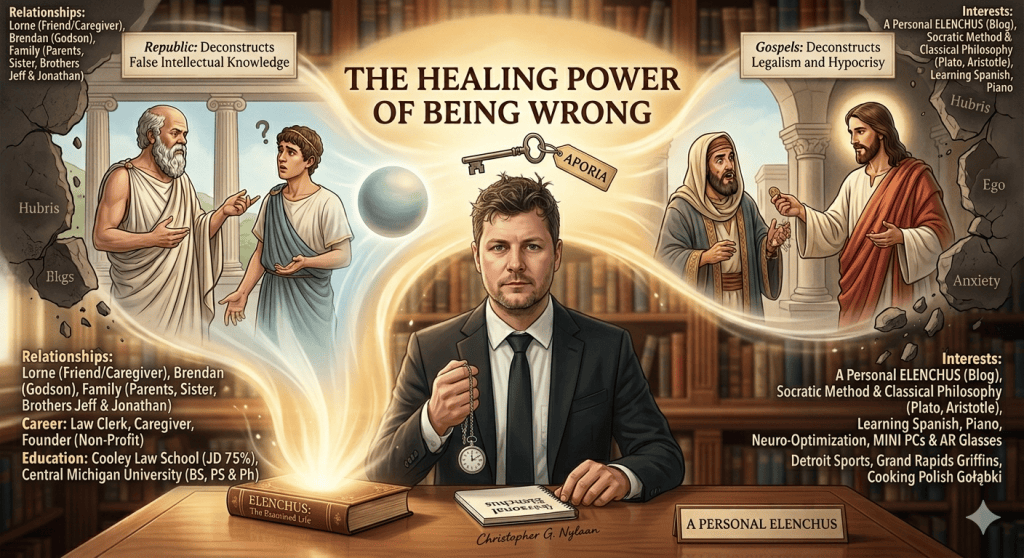
We live in a culture obsessed with being right. From social media arguments to our own internal monologues, we spend an exhausting amount of energy defending our assumptions, protecting our egos, and pretending we have it all figured out.
But what if the truest path to mental clarity and spiritual peace isn’t doubling down on what we think we know? What if healing actually begins when our false certainties are systematically dismantled?
This is why I chose to call this space **A Personal Elenchus**.
The word *elenchus* (traditionally spelled from the Greek *elenchos*, meaning “refutation” or “cross-examination”) might sound like dry philosophy, but it is actually one of the most radical, therapeutic tools ever devised for the human soul. To practice a personal elenchus is to intentionally cross-examine your own beliefs, habits, and anxieties to strip away what is false and find what is real.
## The Therapeutic Effect of Mental Untangling
At first glance, having your beliefs challenged sounds uncomfortable, not therapeutic. But think about the weight of carrying around biases, unexamined fears, and inherited dogmas. It’s heavy.
In psychology, we talk about cognitive restructuring—identifying and disrupting unhelpful thought patterns. Thousands of years before modern therapy, the elenchus did exactly this. It cures a specific spiritual and psychological sickness: **hubris**, or the illusion of knowledge.
When we put our assumptions on the witness stand, we experience what the ancients called *aporia*—a state of puzzled helplessness. While *aporia* feels confusing at first, it is profoundly liberating. It breaks the rigid mental frameworks that cause us chronic anxiety and opens up room to breathe, learn, and grow.
> “The unexamined life is not worth living.” — Socrates
>
## Alive in the *Republic*: Socrates and the Clean Slate
To see the elenchus in its purest form, we have to look at Socrates in Plato’s *Republic*. Socrates didn’t lecture people; he asked questions until his conversational partners tripped over their own contradictions.
In Book I of the *Republic*, a young man named Polemarchus confidently asserts that justice is simple: *”You help your friends and you hurt your enemies.”*
Instead of arguing, Socrates gently guides him through a series of questions:
* *Can we always tell who our true friends are? Don’t we often mistake bad people for friends and good people for enemies?*
* *If we injure an enemy, do we make them more just or less just?*
Through this dialogue, Polemarchus is forced to realize that injuring someone can never be the work of justice. His rigid, tribal view of the world crumbles.
This isn’t a intellectual parlor trick; it’s surgery on the soul. Socrates used the elenchus to shake citizens out of their autopilot thinking, forcing them to realize that a healthy society requires individuals with deeply examined, healthy souls.
## Alive in the Gospels: Jesus and the Mirror of the Heart
While Socrates used the elenchus to target the intellect, Jesus Christ used it in the New Testament to target the human heart. We often think of Jesus as a teacher who only delivered monologues, but the Gospels show him as a master of the dialectic. He routinely answered trap questions with a counter-question that acted as a spiritual elenchus, forcing his challengers into a moment of deep self-examination.
Consider the famous trap set by the religious leaders regarding Roman taxes (Matthew 22): *”Is it lawful to pay taxes to Caesar, or not?”*
If Jesus said yes, he would alienate the oppressed Jewish populace. If he said no, he could be arrested by Rome for sedition. It seemed like a perfect logical corner.
Jesus didn’t give a direct answer. Instead, he initiated an elenchus:
> “Show me the coin used for the tax.” They brought him a denarius, and he asked them, “Whose image is this? And whose inscription?”
> “Caesar’s,” they replied.
> Then he said to them, “So give back to Caesar what is Caesar’s, and to God what is God’s.”
>
By forcing them to produce the Roman coin (which they shouldn’t have even been carrying in the temple) and make them state whose face was on it, Jesus turned the cross-examination back on them. He exposed their internal hypocrisy and left them in a state of absolute *aporia*—they walked away in silence.
We see this same therapeutic refutation when he defends the woman caught in adultery (*”Let him who is without sin cast the first stone”*). He doesn’t debate the law; he asks a question of their consciences, forcing an internal elenchus that makes the accusers drop their stones and walk away, starting with the eldest.
## Making It Personal
| The Socratic Elenchus | The Christian Elenchus | The Personal Elenchus (Our Goal) |
|—|—|—|
| Deconstructs **false intellectual knowledge** to find truth. | Deconstructs **legalism and hypocrisy** to find the heart’s motive. | Deconstructs **our anxieties and ego** to find mental and spiritual peace. |
Using the term *A Personal Elenchus* for this blog is a commitment to that exact process. It means this space isn’t about collecting comfortable answers or reinforcing echo chambers. It’s about asking the hard, necessary questions of ourselves:
* *Why does this specific criticism trigger me so deeply?*
* *Is the story I am telling myself about my failures actually true?*
* *What am I holding onto simply because I’m afraid to admit I was wrong?*
The elenchus is alive because truth is alive. And sometimes, the most healing thing we can do is let our illusions get broken so that something genuine can be built in their place. Welcome to the dialogue.


 A Personal ELENCHUS