The Theology of Presence: A Biblical and Exegetical Analysis of Tollean Mysticism, Christological Identity, and the Kingdom of Heaven
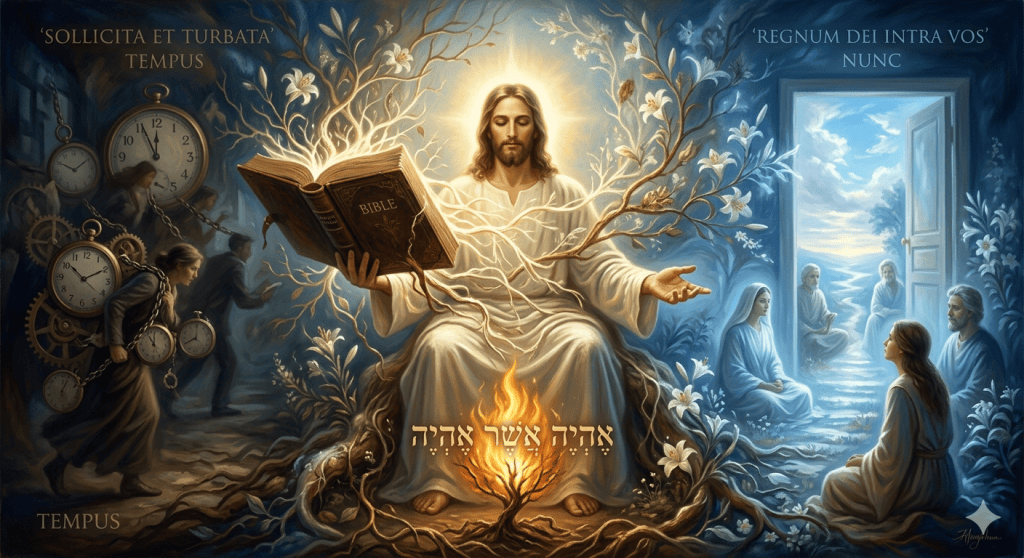
An Exhaustive Theological Treatise Cross-Examining Modern Mindfulness and Scriptural Revelation
Abstract
This paper provides a rigorous, multi-tiered biblical analysis of the concepts articulated in the preceding synthesis of Eckhart Tolle’s philosophy and Christological theology. By cross-examining the core pillars of the blog post—the distinction between the historical Jesus and the eternal I Am, the internal nature of the Kingdom of Heaven, the definition of faith as radical non-resistance to the Divine Will, and the prioritization of ontological “Being” over teleological “Doing”—this study maps modern concepts of “Presence” directly against Old Testament (Tanakh) and New Testament (Gospel and Epistolary) scriptures. The objective is to evaluate where perennial mysticism and canonical scripture converge, providing exhaustive textual evidence to support, ground, and contextualize a lifestyle rooted in divine awareness.
Introduction: The Convergent Streams of Truth
The human mind has an innate tendency to institutionalize truth, spinning complex webs of dogma, historical literalism, and ritualistic obligations around insights that were originally intended to liberate the human spirit. In the blog post titled “Stripping Away the Dogma: A Conversation on Presence, Christ, and the Kingdom Within,” the author engages in a personal elenchus—a Socratic method of cross-examination—to strip away these heavy cultural accretions.
To evaluate whether this modern “Theology of Presence” holds foundational weight or if it stands as an extra-biblical philosophy, we must turn directly to the texts of the Old and New Testaments. When we subject Tolle’s conceptual framework to an exhaustive scriptural audit, we discover that the Bible is not merely a historical record of events or a book of moral rules; it is a profound, living manual of metaphysical awakening. From the burning bush of Exodus to the radical, paradigm-shifting discourses of Jesus in the Synoptic and Johannine Gospels, the Bible consistently demands a transition from egoic self-preservation to absolute divine alignment.
Section I: Christology — The Historical Jesus vs. The Eternal “I Am” (Logos)
The first pillar of the blog post addresses the identity of Jesus, arguing for a crucial distinction between the historical figure of Jesus of Nazareth and the timeless, cosmic reality of the Christ—the unconditioned, formless consciousness that Jesus embodied.
The Old Testament Foundation of the Universal I Am
To understand Jesus’s self-identification, we must return to the foundational metaphysical revelation of the Old Testament. When Moses asks God for His name at the burning bush, the divine response is not a conventional tribal moniker, but an assertion of pure, unconditioned existence:
God said to Moses, “I AM WHO I AM.” And he said, “Say this to the people of Israel: ‘I AM has sent me to you.’” (Exodus 3:14, ESV)
The Hebrew phrasing, Ehyeh Asher Ehyeh, translates literally to “I will be what I will be” or “I am the Being One.” This indicates that the ultimate reality of God is not an object within the universe—not a “supreme being” among other beings—but the very ground of Being itself. The prophet Isaiah reinforces this timeless, unconditioned reality of God as existing outside of chronological progression:
“Listen to me, O Jacob, and Israel, whom I called! I am he; I am the first, and I am the last.” (Isaiah 48:12, ESV)
The Johannine Revelation of Ego Eimi
When Jesus appears in the New Testament, particularly in the Gospel of John, he deliberately invokes this precise metaphysical name (Ego Eimi in the Greek Septuagint text) to signal his true identity. He explicitly decouples his true self from his linear, historical lineage:
Jesus said to them, “Truly, truly, I say to you, before Abraham was, I am.” (John 8:58, ESV)
The religious authorities of his day understood exactly what he was saying: he was not claiming to be a very old human being, but was identifying himself directly as the timeless, formless presence of God. He was speaking from the place of the unconditioned Logos. John introduces this reality in the prologue of his Gospel:
In the beginning was the Word, and the Word was with God, and the Word was God. He was in the beginning with God. All things were made through him, and without him was not any thing made that was made. In him was life, and the life was the light of men. (John 1:1-4, ESV)
The Word (the Greek Logos) is the divine blueprint, the light of consciousness through which the entire manifest universe arises.
The Indwelling Christ and Human Awakening
The blog post asserts that Jesus’s self-realization was an invitation rather than an exclusive exception. This matches the theology of the Apostle Paul, who constantly writes about Christ not merely as an external savior, but as an internal reality indwelling every human being:
To them God chose to make known how great among the Gentiles are the riches of the glory of this mystery, which is Christ in you, the hope of glory. (Colossians 1:27, ESV)
Paul does not say “Christ beside you” or “Christ after you die,” but explicitly “Christ in you.” He further describes this radical shift in identity—away from the egoic self (the “I” of the personality) and into the divine presence—in his letter to the Galatians:
I have been crucified with Christ. It is no longer I who live, but Christ who lives in me. And the life I now live in the flesh I live by faith in the Son of God, who loved me and gave himself for me. (Galatians 2:20, ESV)
Egoic Identity (The “I” of Personality) ──> Crucifixion/Dissolution ──> Divine Presence (Christ living in me)
When Jesus utters his most famous, often-monopolized statement, he is inviting humanity into this exact state of unconditioned realization:
Jesus said to him, “I am the way, and the truth, and the life. No one comes to the Father except through me.” (John 14:6, ESV)
When read through the lens of institutional dogma, this is treated as an exclusionary gatekeeping mechanism. However, when analyzed textually alongside John 1:1-4 and Exodus 3:14, “the way, the truth, and the life” is the I Am—the primordial light of consciousness itself. No human being can connect with the formless Source (the Father) except through the portal of their own conscious presence (I Am).
Section II: The Kingdom of Heaven — Immanent Reality vs. Eschatological Location
The second major point of the blog post addresses the nature of the Kingdom of Heaven, directly confronting the common narrative that heaven is a far-off geographical or post-mortem destination.
Aspect
Conventional Institutional View
Biblical Mystical View (Tolle/Jesus)
Location
A physical realm above the sky
An immanent, internal reality
Timing
Accessed exclusively after physical death
Accessible right here, in the present moment
Prerequisite
Adherence to historical and dogmatic checklists
Awakening to unconditioned, silent awareness
The Definitive Lucan Declaration
The primary biblical anchor for this concept comes from a direct confrontation between Jesus and the religious authorities of his era, who were looking for an external, political, or catastrophic shift in the material world:
Being asked by the Pharisees when the kingdom of God would come, he answered them, “The kingdom of God is not coming with signs to be observed, nor will they say, ‘Look, here it is!’ or ‘There!’ for behold, the kingdom of God is in the midst of you.” (Luke 17:20-21, ESV)
The Greek phrase used here, entos hymon, has been translated both as “within you” and “in your midst.” Both translations cleanly dismantle the idea of an external, localized destination. Jesus explicitly warns against looking “here” or “there”—meaning, looking into spatial locations or future timelines. The Kingdom is an immediate, omnipresent reality that can only be entered by shifting one’s internal state of awareness.
The Old Testament Revelation of Omnipresent Reality
This concept of God’s kingdom as an inescapable, all-pervading field of presence rather than a distinct place is woven throughout the Psalms. King David notes the impossibility of escaping this divine field:
Where shall I go from your Spirit? Or where shall I flee from your presence? If I ascend to heaven, you are there! If I make my bed in Sheol, you are there! If I take the wings of the morning and dwell in the uttermost parts of the sea, even there your hand shall lead me, and your right hand shall hold me. (Psalm 139:7-10, ESV)
If the Divine Presence is equally available in Heaven, Sheol (the underworld), and the uttermost parts of the sea, then “Heaven” cannot be defined by physical geography. It is the conscious recognition of that Presence. The prophet Isaiah quotes God to emphasize the futility of building a localized house for a formless, infinite reality:
Thus says the Lord: “Heaven is my throne, and the earth is my footstool; what is the house that you would build for me, and what is the place of my rest?” (Isaiah 66:1, ESV)
Entering the Kingdom Through the Portal of the “Now”
Jesus consistently emphasizes that the time to enter this kingdom is not in some distant future, but immediately:
and saying, “The time is fulfilled, and the kingdom of God is at hand; repent and believe in the gospel.” (Mark 1:15, ESV)
The phrase “at hand” (ēngiken in Greek) means imminently close, within arm’s reach, available right here and now. The word translated as “repent” is metanoeite, which literally means “change your mind” or “go beyond your current mode of thinking.” Jesus is calling for a radical shift in consciousness: step out of your conditioned, egoic thought structures (metanoia) and awaken to the Kingdom that is already “at hand” in the present moment.
Section III: Faith (Pistis) and the Divine Will — The Geometry of Surrender
The third section of the blog post examines the distortion of “faith” and “God’s will,” redefining faith as a deep, non-conceptual trust in life, and God’s will as the absolute acceptance of the present moment.
The Anatomy of Non-Resistance: The Sermon on the Mount
In his foundational discourse, Jesus provides a masterclass in what Eckhart Tolle calls “non-resistance”—the complete abandonment of psychological anxiety regarding the future, grounded in an absolute trust in the present:
“Therefore I tell you, do not be anxious about your life, what you will eat or what you will drink, nor about your body, what you will put on. Is not life more than food, and the body more than clothing? Look at the birds of the air: they neither sow nor reap nor gather into barns, and yet your heavenly Father feeds them. Are you not of more value than they? And which of you by being anxious can add a single hour to his span of life?” (Matthew 6:25-27, ESV)
Jesus directs his listeners’ attention to nature—to the birds and the lilies—because elements of nature exist in a state of pure, unconditioned being. They do not possess an egoic mind that projects past regrets or future terrors. They are fully aligned with the rhythm of existence. He continues:
“And why are you anxious about clothing? Consider the lilies of the field, how they grow: they neither toil nor spin, yet I tell you, even Solomon in all his glory was not arrayed like one of these… Therefore do not be anxious, saying, ‘What shall we eat?’ or ‘What shall we drink?’ or ‘What shall we wear?’… But seek first the kingdom of God and his righteousness, and all these things will be added to you. Therefore do not be anxious about tomorrow, for tomorrow will be anxious for itself. Sufficient for the day is its own trouble.” (Matthew 6:28-29, 31, 33-34, ESV)
Egoic Anxiety (What shall we eat/wear?) ──> Focus on Tomorrow (Illusion)
│
[ Radical Shift ]
▼
Divine Alignment (Consider the lilies) ──> Seek the Kingdom Now (Reality)
By explicitly commanding his followers to abandon anxiety about “tomorrow,” Jesus anchors true faith entirely in the Now. “His righteousness” (dikaiosynē) can be translated as divine right alignment—being in perfect harmony with the cosmic order, which can only occur in the present moment.
The Ultimate Surrender at Gethsemane
The blog post frames God’s will not as a complex script for the future, but as the concrete reality of what is happening right now. The supreme example of this radical surrender occurs in the Garden of Gethsemane, where Jesus faces his impending torture and execution. The human ego naturally resists suffering and death, but Jesus demonstrates the absolute collapse of inner resistance:
And going a little farther he fell on his face and prayed, saying, “My Father, if it be possible, let this cup pass from me; nevertheless, not as I will, but as you will.” (Matthew 26:39, ESV)
By saying “not as I will, but as you will,” Jesus demonstrates the absolute dissolution of the personal, egoic will. He drops all psychological resistance to the reality of the present moment, even when that moment presents the ultimate earthly terror. This is the absolute peak of alignment with the Divine Will.
Old Testament Directives on Stillness and Trust
This radical non-resistance is directly supported by the wisdom literature and prophetic texts of the Old Testament. The book of Psalms summarizes the entire methodology of awakening into a single sentence:
“Be still, and know that I am God. I will be exalted among the nations, I will be exalted in the earth!” (Psalm 46:10, ESV)
The Hebrew command for “Be still” is Harpu, which means to let go, to cease striving, to slacken, or to surrender. It is not an invitation to passive laziness; it is a command to quiet the turbulent waters of the thinking mind so that the underlying reality of God (I Am) can be known. Solomon echoes this in the book of Proverbs, explicitly warning against relying on the ego’s conceptual interpretations of reality:
Trust in the Lord with all your heart, and do not lean on your own understanding. In all your ways acknowledge him, and he will make straight your paths. (Proverbs 3:5-6, ESV)
To “lean on your own understanding” is to rely entirely on the mind’s conditioned labels, judgments, and categories. To “acknowledge him in all your ways” is to remain anchored in the light of divine presence across every life situation.
Section IV: The Teleology of Human Existence — Being vs. Doing (The Mary and Martha Paradigm)
The final section of the blog post addresses the fundamental purpose of life, noting that human society prioritizes “Outer Purpose” (doing, creating, achieving), whereas the universe prioritizes “Inner Purpose” (pure ontological Being).
The Exegetical Analysis of Luke 10:38-42
The archetypal narrative illustrating the tension between the functional world of doing and the foundational reality of being is the story of Martha and Mary:
Now as they went on their way, Jesus entered a village. And a woman named Martha welcomed him into her house. And she had a sister called Mary, who sat at the Lord’s feet and listened to his teaching. But Martha was distracted with much serving. And she went up to him and said, “Lord, do you not care that my sister has left me to serve alone? Tell her then to help me.” (Luke 10:38-40, ESV)
Martha represents the hyper-active, modern paradigm. She is consumed by outer purpose, utility, and societal expectations. The text specifically highlights her state of mind: she was “distracted” (periespato, meaning pulled in many directions, dragged away, or mentally over-occupied). Her external doing has triggered internal resentment and anxiety. Jesus’s response serves as an eternal correction to this mindset:
But the Lord answered her, “Martha, Martha, you are anxious and troubled about many things, but one thing is necessary. Mary has chosen the good portion, which will not be taken away from her.” (Luke 10:41-42, ESV)
Martha (Outer Purpose) ──> “Anxious and troubled about many things” ──> Fragmented Doing
Mary (Inner Purpose) ──> “One thing is necessary” ──> Anchored Being
Jesus does not criticize the act of hospitality itself, but rather the internal quality of consciousness that Martha brings to it (“anxious and troubled”). He explicitly states that only “one thing is necessary.” That single necessity is absolute presence—the silent, receptive, non-judgmental awareness embodied by Mary as she sits at his feet. This inner connection is the “good portion” that belongs to the eternal realm and can never be destroyed by the shifting tides of the material world.
The Metaphor of the Vine and the Branches
In the Gospel of John, Jesus uses a vivid horticultural metaphor to demonstrate that all meaningful external action (doing) must emerge as a natural, effortless byproduct of deep internal alignment (being):
“I am the vine; you are the branches. Whoever abides in me and I in him, he it is that bears much fruit, for apart from me you can do nothing.” (John 15:5, ESV)
The word “abide” (meinate in Greek) means to remain, to stay, to dwell permanently. Jesus explicitly states that the branch cannot manufacture fruit through its own striving or straining. The fruit is an effortless expression of the sap flowing from the vine into the branch.
If a human being is disconnected from the central vine of Presence, their outer actions (doing) are born of ego, fear, and lack, ultimately resulting in spiritual exhaustion. When an individual abides deeply in the I Am, their outer actions become “fruit”—effortless expressions of divine grace.
The Singleness of Focus
To ensure that outer actions are filled with light, Jesus notes the absolute necessity of maintaining an undivided internal gaze:
“The eye is the lamp of the body. So, if your eye is healthy, your whole body will be full of light, but if your eye is bad, your whole body will be full of darkness. If then the light in you is darkness, how great is the darkness!” (Matthew 6:22-23, ESV)
The Greek word translated as “healthy” or “single” is haplous, which means uncomplicated, unified, or free from duplication. If your internal focus is “single”—meaning you are anchored squarely in the unified presence of the Now—your entire life expression (your body) will be infused with divine light. If your gaze is divided by the ego’s past and future projections, your life descends into darkness and fragmentation.
Section V: Synthesis and Critical Theological Evaluation
When we synthesize the scriptural record with the core principles of modern mindfulness as expressed in the personal elenchus blog post, we can trace a clear map of textual corroboration:
Blog Post Concept
Tolle / Presence Framework
Comprehensive Biblical Corroboration
The True Identity of Jesus
Shifting focus from historical ego to the timeless, universal I Am.
Exodus 3:14: Ehyeh Asher Ehyeh John 8:58: “Before Abraham was, I am.” Colossians 1:27: “Christ in you, the hope of glory.”
The Kingdom of Heaven
An internal state of unconditioned awareness, not a spatial location.
Luke 17:21: “The kingdom of God is within you.” Psalm 139: The absolute omnipresence of the Divine Spirit.
Faith and Divine Will
Radical non-resistance to the present moment; dropping all anxiety.
Matthew 6:25-34: The command to live like the lilies, ignoring tomorrow. Matthew 26:39: “Not as I will, but as you will.”
Ultimate Life Purpose
Prioritizing Inner Being over the endless distractions of Outer Doing.
Luke 10:41-42: Mary choosing the “one thing necessary” over Martha’s distraction. John 15:5: Abiding in the vine to bear fruit effortlessly.
Resolving Potential Theological Tensions
While the alignment between these two frameworks is substantial, a rigorous analysis must address one key point of tension: the problem of human sin and the necessity of redemption.
In some modern interpretations of mindfulness, the ego is viewed simply as a cognitive mistake or an illusion that can be dissolved by shifting one’s attention. Traditional biblical theology, however, frames this separation using the word Sin (Greek Hamartia, meaning “to miss the mark”). The Bible presents this state of separation not merely as a minor mental error, but as a deep, systemic condition of spiritual death:
And you were dead in the trespasses and sins in which you once walked, following the course of this world, following the prince of the power of the air, the spirit that is now at work in the sons of disobedience— (Ephesians 2:1-2, ESV)
Does this reality conflict with the Theology of Presence? Not at all. In fact, it provides a deeper diagnostic tool for it. What is the “course of this world” if not the collective, unawakened egoic mind of humanity? To be spiritually “dead” is to live as a complete prisoner to the mechanical loops of conditioned thought, personal trauma, and societal programming.
The biblical concept of salvation (Soteria, meaning healing, deliverance, and restoration to wholeness) aligns cleanly with the process of spiritual awakening. When Jesus calls humanity to experience a spiritual rebirth, he is describing a complete shift in consciousness:
Jesus answered him, “Truly, truly, I say to you, unless one is born again he cannot see the kingdom of God.” (John 3:3, ESV)
To be “born again” or “born from above” is to experience the complete collapse of your old, thought-constructed, historical identity. It is to step out of the identity you inherited from the flesh and historical conditioning, and step directly into your true identity as a child of God, born of the formless Spirit.
Conclusion: The Living Invitation
The exhaustive scriptural record indicates that the blog post under analysis does not present a superficial or extra-biblical philosophy. Instead, it recovers the core mystical core of the Judeo-Christian tradition that institutional dogma often obscures.
The Bible speaks with a clear, unified voice across both Testaments. It relentlessly calls humanity away from the exhausting illusions of the past and future, away from the frantic anxiety of the egoic mind, and away from the shallow validation of external performance. It issues a profound, open invitation to step directly into the sanctuary of the present moment.
As the prophet Zechariah declared to a restless world:
“Be silent, all flesh, before the Lord, for he has roused himself from his holy dwelling.” (Zechariah 2:13, ESV)
The holy dwelling of God is not a golden temple in ancient Jerusalem, nor is it a structural palace beyond the stars. His holy dwelling is the eternal Now, found within the quiet depths of your own conscious presence. The evidence is explicit, repetitive, and undeniable: to find God, you must drop your mental stories, step out of the illusion of tomorrow, and awaken to the I Am that has been looking through your eyes since the beginning of time.


 A Personal ELENCHUS