The Gordian Knot of the Holy Land: Geopolitics, Myth, and the U.S.-Israel Alliance
To the outside observer, the alliance between the United States and Israel is a profound paradox. It is a partnership that spans decades, surviving administration changes, global realignments, and intense regional wars. Yet, it is also an alliance where the two nations frequently operate on fundamentally divergent timelines and priorities.
Look no further than the fractured reality of April 2026: The United States and Iran negotiate a fragile ceasefire to pause direct hostilities, desperate to maintain global economic stability. Simultaneously, Israel intensifies its strikes against Hezbollah in Lebanon. How does an alliance function when one partner is trying to extinguish a regional fire, while the other believes it must fight through the flames?
To explain this dynamic to the next generation, we have to deconstruct the myths of the alliance and examine its true foundation: a volatile collision of cold geographic strategy, inflated security threats, and ancient theological myths.
The Geopolitical Foundation: Utility Over Dogma
Is the alliance based on religious ideology? Yes, but not in the way it is often caricatured. In the United States, a significant driver of pro-Israel foreign policy comes from right-wing Christian Zionism. For many evangelical Christians, the modern State of Israel is inextricably linked to biblical prophecy. Conversely, the theological foundations of Judaism do not share these specific eschatological views, and historically, significant religious frictions remain between the faiths.
However, in the realm of statecraft, theology is subordinated to survival. Israel pragmatically accepts the fierce political backing of American Christian voting blocs. It is a marriage of profound domestic political utility rather than shared dogma.
Furthermore, the alliance is not, and never was, about Middle Eastern oil. Israel historically had no oil to offer. The roots of the modern alliance trace back to the Cold War, where the U.S. viewed Israel as a democratic bulwark against Soviet influence. Over the decades, this strategic convenience evolved into deep institutional integration, sustained by massive intelligence sharing and military technology development.
The Map vs. The Myth
To understand the discord of 2026, we have to strip away the rhetoric and look directly at a map. Geographically, Israel is a profoundly vulnerable sliver of land in the Levant, roughly the size of New Jersey. It lacks any real strategic depth; there is virtually no physical buffer between hostile borders and civilian centers. From the Israeli perspective, a militant threat originating in southern Lebanon is a direct danger to their front doors, dictating a national security doctrine built on overwhelming, preemptive action.
Yet, for a massive bloc of right-wing Americans, this stark geopolitical reality is entirely obscured by a clouded, theological vision. They view the map of the Middle East merely as an overlay on ancient biblical topography. Their support is anchored not in democratic solidarity, but in a rigid interpretation of scriptural prophecy, viewing the defense of Israel as a strict prerequisite for future “end times” events.
This creates a profoundly destabilizing dynamic. When a significant portion of the U.S. electorate views a foreign ally through the lens of inevitable, divine prophecy, Washington cannot act as an objective, stabilizing force. A tactical military campaign in Lebanon ceases to be a calculated maneuver; it is cheered on by domestic voters as the righteous unfolding of biblical destiny.
The Illusion of Objective Threats and Ancient Borders
This clouded vision becomes even more dangerous when used to justify broader regional conflicts, particularly regarding Iran. The rationale for continuously aggressively posturing toward Iran—and even engaging in direct strikes—is frequently framed as an absolute security necessity. However, a Socratic examination of this stance reveals it is rarely entirely objective.
While Iran undoubtedly funds proxy groups, the framing of Tehran as an imminent, apocalyptic threat is often leveraged more for maintaining political cohesion and justifying a perpetual war footing than responding to an objective danger. It is a manufactured escalation that serves the hardliners in both nations, keeping populations fearful and compliant.
This reliance on exaggerated narratives is deeply tied to the foundational myths of the region. The biblical “Promised Land” described in antiquity is vastly larger than the sliver of land modern Israel occupies, with scriptures envisioning borders stretching from the river of Egypt to the Euphrates. Yet, modern archaeology and rigorous historical scholarship cast deep doubt on the literal accuracy of these ancient conquests and boundaries.
There is a highly plausible argument that the historical basis for modern prophecy is largely speculation—a collection of foundational myths rather than an accurate historical ledger. Clinging to these ancient texts as modern land deeds elevates myth over reality.
The Tragedy of the Radicals
Ultimately, this reliance on myth over history fuels needless bloodletting. The conflict in the Middle East is continually hijacked and weaponized by the radical, misguided fringes of three major faiths: Islam, Christianity, and Judaism.
Instead of negotiating the very real, physical challenges of sharing a geographically cramped and resourced-starved region, radical factions within all three religions elevate the conflict to a cosmic struggle. They fight over land that history cannot definitively prove belonged to their ancestors in the way their holy books claim, driven by prophecies that require human suffering to be fulfilled.
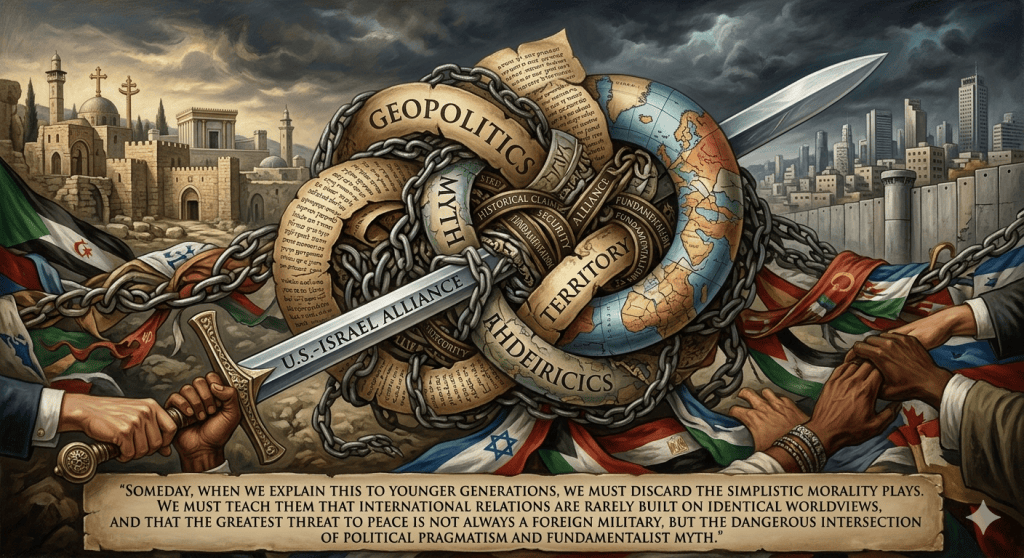
Someday, when we explain this to younger generations, we must discard the simplistic morality plays. We must teach them that international relations are rarely built on identical worldviews, and that the greatest threat to peace is not always a foreign military, but the dangerous intersection of political pragmatism and fundamentalist myth.


 A Personal ELENCHUS