The Tightrope of the Mind: Navigating Bipolar I and ADHD
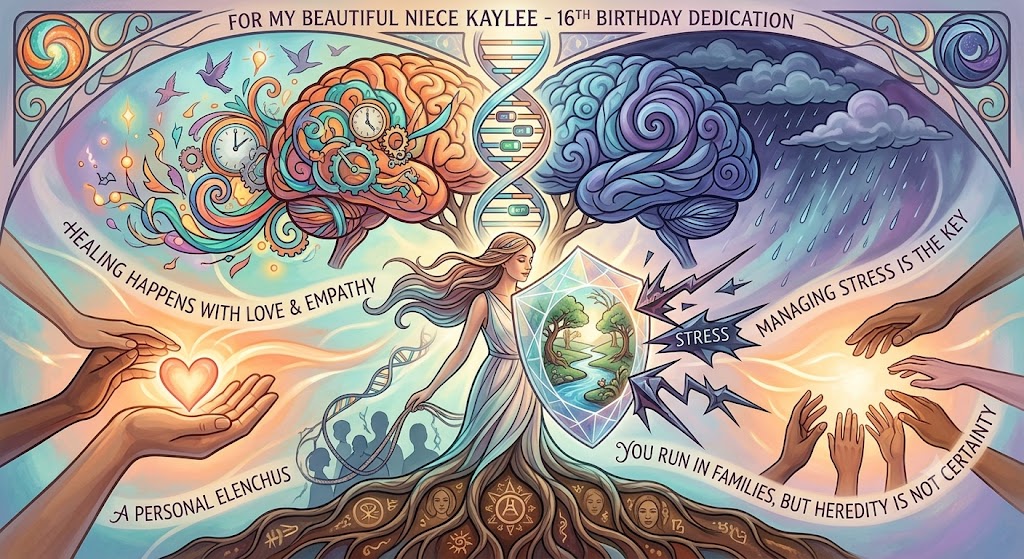
Dedicated to my beautiful niece, Kaylee, on her 16th birthday. It is my deepest hope that you never have to navigate the traumatizing realities I have faced with these disorders. May your path be defined by peace, understanding, and unyielding support.
There is a profound vulnerability in pulling back the curtain on the mind, especially when the mind operates a little differently than most. Here on A Personal Elenchus, the goal has always been to seek truth through questioning. Today, that truth is intensely personal. It’s about the reality of living with a dual diagnosis of Bipolar I and Attention-Deficit/Hyperactivity Disorder (ADHD)—a complex intersection of neurobiology that demands both incredible resilience and profound grace.
To understand this journey, we first have to define the terrain.
Defining the Storm: Bipolar I and ADHD
Bipolar I Disorder is characterized by severe shifts in mood, energy, and activity levels. At its core are manic episodes—periods of intensely elevated, irritable, or energized behavior that last at least a week, sometimes requiring hospitalization. These highs are often, though not always, followed by crushing depressive episodes.
ADHD, on the other hand, is a neurodevelopmental disorder marked by an ongoing pattern of inattention, hyperactivity, and impulsivity that interferes with daily functioning or development.
When these two conditions coexist—a state known as comorbidity—the mind is caught in a unique crossfire.
The Treatment Paradox
Treating this specific combination is notoriously difficult, largely because the standard treatments for one can act as the match that ignites the other.
The frontline medications for ADHD are often stimulants. They help focus the mind and regulate impulsive behavior. However, for a brain wired with Bipolar I, a stimulant can be incredibly dangerous. It can act as a catalyst, pushing an elevated mood straight into full-blown mania. Conversely, mood stabilizers prescribed to keep Bipolar I episodes at bay can sometimes cause cognitive dulling or fatigue, which only exacerbates the inattention and executive dysfunction of ADHD.
Psychiatrists treating this comorbidity must walk a pharmacological tightrope. It requires constant adjustments, deep patience, and an acceptance that finding equilibrium is a marathon, not a sprint.
Heredity, Destiny, and the Myth of Certainty
When faced with a mental health diagnosis, one of the first questions we ask is: Where did this come from?
It is a well-established medical fact that mental illnesses, including Bipolar disorder and ADHD, run in families. If you have a close relative with the condition, your statistical susceptibility is higher. It is vital to be aware of your family history, much like you would with heart disease or diabetes.
But here is the crucial caveat: susceptibility is not a life sentence.
It is not a certainty that mental illnesses are strictly and always genetic. The emerging science of epigenetics shows us that environmental factors, trauma, and lifestyle play a massive role in whether certain genetic switches are turned “on” or “off.” You can carry the genetic blueprint for a disorder and never experience a single symptom in your lifetime.
The Ultimate Buffer: Managing Stress
If genetics load the gun, environment pulls the trigger. And the heaviest trigger of all is stress.
The profound truth about living with—or actively preventing—mental illness is that managing your stress level is the key to remaining symptom-free. Chronic stress elevates cortisol, disrupts sleep architecture, and fries the nervous system. For a neurodivergent brain, a high-stress environment is toxic.
Whether you have a diagnosed condition or simply carry a family susceptibility, radical self-care is not a luxury; it is a vital defense mechanism. Prioritizing rest, setting fierce boundaries, exercising, and finding quiet moments to decompress are the literal shields that protect the mind’s fragile equilibrium.
Healing Through Empathy
Why do we talk about this? Because silence breeds stigma, and stigma is a secondary disease that is often deadlier than the diagnosis itself.
When we stigmatize mental illness—when we whisper about it, mock it, or treat it as a moral failing rather than a biological reality—we isolate those who are suffering. We force people to carry their heaviest burdens in the dark, out of fear of being judged or misunderstood.
Healing does not happen in isolation. It happens when we meet each other’s vulnerabilities with love and empathy. It happens when we look at a mind in turmoil and, instead of turning away, we offer a steady hand.
To Kaylee, as you step into your 16th year, and to everyone reading this: fiercely protect your peace. Manage your stress. Be relentlessly kind to those whose minds are fighting battles you cannot see. And never underestimate the healing power of simply choosing to understand.


 A Personal ELENCHUS