The Law and Love
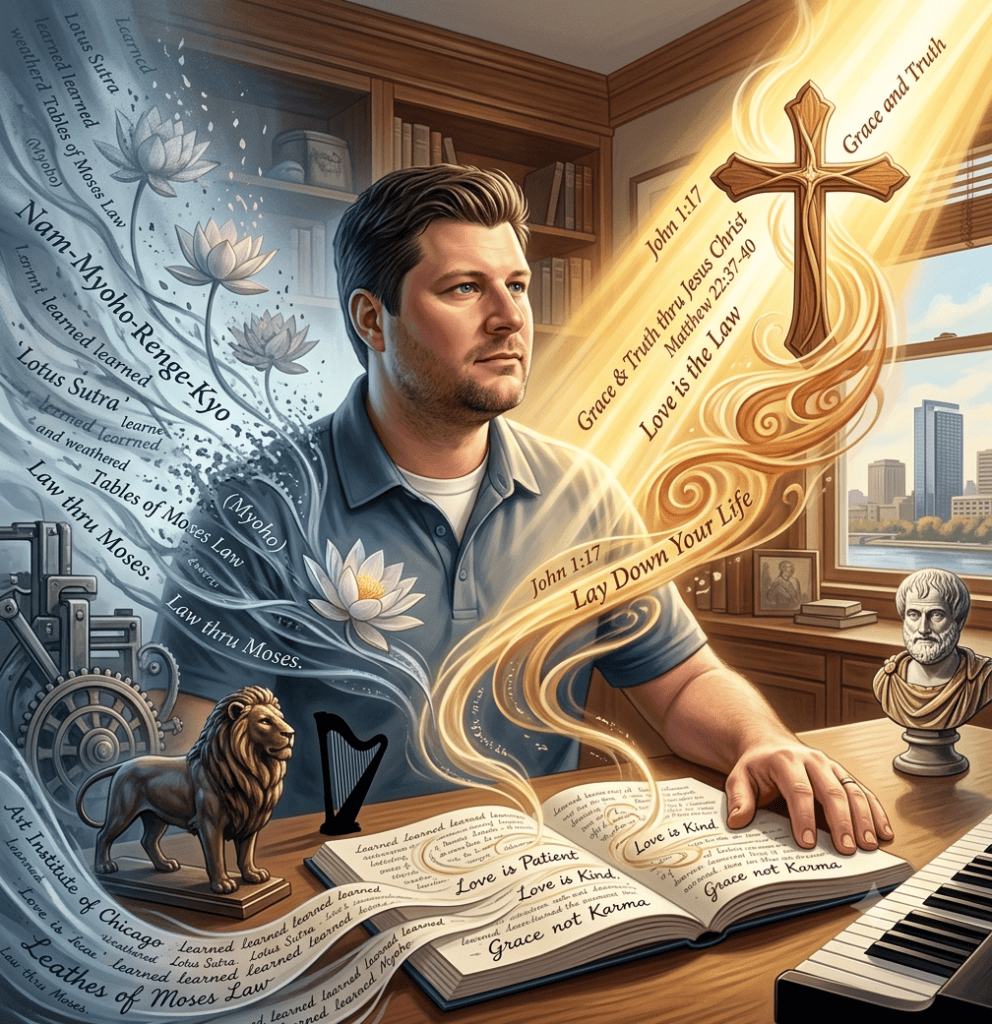
Welcome to another entry of *A Personal Elenchus*. Today, we are examining a philosophical and spiritual intersection: the teachings of Nichiren Daishonin, the Lotus Sutra, and the ultimate reality of the Gospel.
If you look closely at the world’s major philosophies, you often find arrows pointing toward a singular, ultimate truth. But it is crucial to get the direction of those arrows right. Jesus wasn’t pointing forward to Nichiren; rather, the concepts Nichiren wrestled with ultimately point back to Jesus. Christ is the original light.
With that said, we don’t have to dismiss the Eastern pursuit of truth entirely. There are profound benefits and reflections to be found in *Nam-Myoho-Renge-Kyo*, provided we understand the “Law” it refers to through the correct lens.
## The Law vs. Grace and Truth
In Nichiren Buddhism, practitioners chant *Nam-Myoho-Renge-Kyo*, which translates to dedicating one’s life to the Mystic Law of the Lotus Sutra. “Myoho” represents this supreme, universal law.
But as Christians, we understand the origins and the limitations of the law. As John 1:17 reminds us, the law (*Myoho*) came through Moses, but grace and truth came through Jesus Christ.
Nichiren’s framework struggles to fully explain the grace that must accompany the law. A universal law of cause and effect (karma) is ultimately a rigid, demanding master. It dictates that every action requires an equal reaction, leaving humanity trapped in a cycle of trying to balance the scales. But Jesus interrupted that cycle. He didn’t abolish the law; He fulfilled it, bridging the gap with grace and truth that a purely mechanical “mystic law” cannot offer.
## Compassion vs. Agape Love
A central pillar of Nichiren’s teaching is compassion—the desire to awaken others and help them alleviate their suffering. Compassion is beautiful, but it is incomplete without love.
Jesus elevated the standard from passive compassion to active, self-giving *agape* love. As the Apostle Paul writes:
> *”Love is patient, love is kind. It does not envy, it does not boast, it is not proud… it keeps no record of wrongs.”* (1 Corinthians 13:4-5)
>
True love does not judge. It steps into the mess of humanity. Jesus showed us that the greatest expression of this is not just wishing well for others or teaching them a philosophy, but total self-sacrifice: *”Greater love has no one than this: to lay down one’s life for one’s friends”* (John 15:13).
## The Living Sacrifice as the End of Suffering
Buddhism is fundamentally built on the goal of avoiding or escaping suffering. But the Gospel offers a radical paradox: the way to transcend suffering is not by escaping it, but by offering your life up entirely for others.
We are called to let Jesus love through us. When you make your life a living sacrifice—pouring everything you do into your brothers, your friends, your family, and your neighbors—you actually break the chains of internal suffering.
> *”Therefore, I urge you, brothers and sisters, in view of God’s mercy, to offer your bodies as a living sacrifice, holy and pleasing to God—this is your true and proper worship.”* (Romans 12:1)
>
When your life is no longer about you, the anxieties, the ego, and the existential suffering that plague the human condition begin to fall away. You avoid the suffering of a self-centered life by willingly taking on the sacrifice of a love-centered life.
## Demystifying the Chant
So, what do we do with *Nam-Myoho-Renge-Kyo*?
If you hear it, or if it crosses your mind, let it serve as a powerful reminder of the sacrifice and the love required by the *true* law. The law does not have to be “mystic” or unknowable. It doesn’t require us to unlock the secrets of the cosmos. Jesus made it brilliantly, startlingly simple.
When asked what the greatest commandment in the Law was, Jesus replied:
*”‘Love the Lord your God with all your heart and with all your soul and with all your mind.’ This is the first and greatest commandment. And the second is like it: ‘Love your neighbor as yourself.’ All the Law and the Prophets hang on these two commandments.”* (Matthew 22:37-40)
The law is not a mystic vibration; the law is love. Let every pursuit of truth point you back to the cross, where that law was perfectly fulfilled.


 A Personal ELENCHUS