
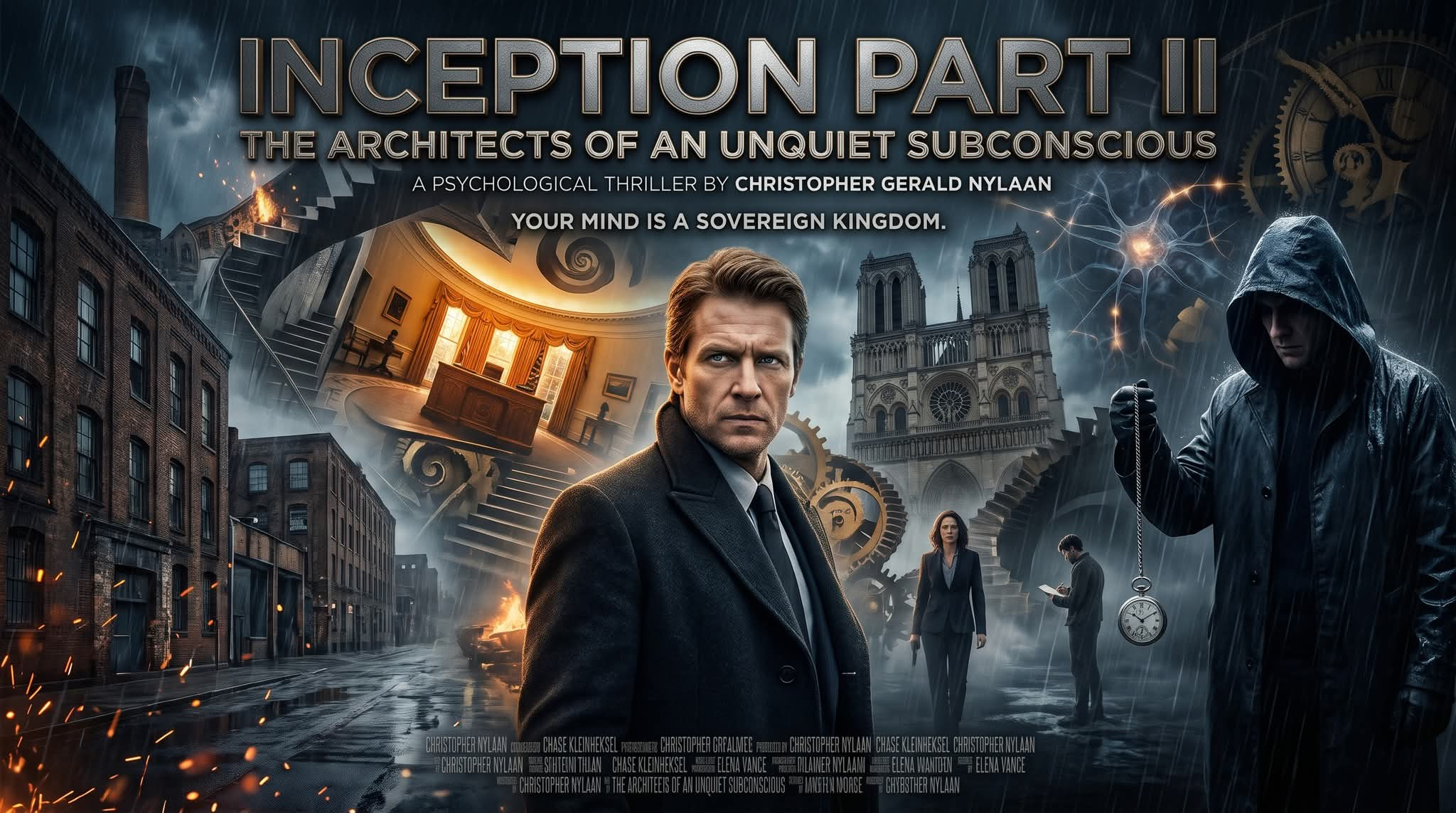
INCEPTION PART II: THE ARCHITECTS OF AN UNQUIET SUBCONSCIOUS
A Psychological Thriller by Christopher Gerald Nylaan
Dedication
To my niece, Kaylee Nylaan, the brilliant daughter of Jeff and Jamie. May you always know that the vastest cathedral on earth is the one built behind your own eyes, that your mind is a sovereign kingdom no shadow can conquer, and that you hold the master key to every locked door of human potential. Walk boldly through the labyrinth, question every premise, and build your own architecture of light.
Author’s Acknowledgements and Architectural Credits
Every cathedral rests upon bedrock laid by master builders who came before, and every expedition into the labyrinth of the human mind owes a debt to the cartographers who first dared to map the dark.
First, enduring credit belongs to Christopher Nolan for the original cinematic masterwork Inception, which gave the modern world a visual vocabulary for shared dreaming, nested realities, and the terrifying gravity of an idea planted deep within the human psyche. Alongside him, immense credit is owed to Leonardo DiCaprio, whose tour-de-force performance as Dom Cobb captured the agonizing human cost of a man haunted by the projections of his own guilt and love. Where their story asked whether a spinning top would ever fall inside a sleeping dream, this book steps into a far more dangerous territory: the waking trance, where eyes remain wide open and the totem never stops spinning because the floor itself has been rebuilt by language.
Visual credit for all conceptual artwork, symbolic plates, and subconscious mindscapes emerging from this manuscript belongs to Chase Kleinheksel, whose artistic vision translates the invisible geometry of thought into living form.
Philosophical and historical gratitude is extended to the silent council of The Authors—the mentors, scholars of emerald history, guardians of moral philosophy, and modern troubadours of melody—whose names are purposefully veiled within the narrative that follows, for true architects are known by the resonance of their work rather than the ink on their passports.
Finally, a tip of the hat is owed to Garth Brooks for his daring psychological experiment with the alter-ego Chris Gaines—a brilliant study in how an artist can construct a secondary identity so complete that the public forgets where the mask ends and the man begins. Yet let the record be stated plainly at the threshold of this book, so that no reader, critic, or shadow in the gallery mistakes the nature of its author: in the fictional mythology of Chris Gaines, the world was offered The Lamb. Christopher Nylaan is not the lamb. He is neither the sacrifice upon the altar of someone else’s narrative nor the passive vessel of an implanted dream. He is the examiner at the gate, the keeper of the Socratic elenchus, and the architect of his own waking mind.
Prologue: The Metronome of the Tell-Tale Mind
True!—nervous—dreadfully, acutely awake I had been, and am; yet why will you say that I am dreaming? The disease—if you dare call the hyper-illumination of every synaptic corridor a disease—had sharpened my senses, not dulled them, not destroyed them. Above all was the sense of hearing acute. I heard all things in the heaven of the prefrontal cortex and in the dark, subterranean earth of the viscera. I heard many things in the unquiet chamber of the ninety percent—that vast, uncharted midnight ocean that sleeps beneath the fragile ten-percent raft of human waking consciousness.
Have you ever listened, in the dead hush of three o’clock in the morning, to the rhythm of your own pulse against the pillow and realized that the beat is not yours alone? That someone—some voice on a screen, some cadence in a four-chord melody, some carefully paced syllable spoken from a podium—has slipped inside the metronome of your chest and adjusted the tempo?
Men lock their front doors with deadbolts of hardened steel. They encrypt their financial ledgers with two-hundred-and-fifty-six-bit primes. They station armed sentries around marble monuments and nuclear silos. Yet they leave the front gates of their own minds wide open to any passerby who knows the syntax of a double-bind, the drop of a baritone inflection, or the rhythmic flash of an anchor. Christopher Nolan showed the world a team of thieves who needed sedatives, intravenous tubes, and a silver briefcase just to slip inside a sleeping man’s dream. That was a mercy compared to the truth. You do not need to put a man to sleep to steal his kingdom. You only need to understand how he listens while he believes he is awake.
Chapter One: The Oval Pendulum
The grandfather clock against the curved western wall of the Oval Office did not merely tick; it swung with the heavy, brassy inevitability of an executioner’s blade.
Tick. Pause. Tock. Pause.
Outside the triple-paned ballistic glass, a November rain lashed the Rose Garden, turning the floodlit colonnade of the West Wing into a blurred ribbon of bone-white marble. Inside, the air smelled of old leather, beeswax, and the ozone tang of panic. It was 11:42 P.M. Across the polished mahogany expanse of the Resolute Desk, the nuclear football rested open inside its leather satchel, tethered to the wrist of a naval aide who stood frozen by the concealed door to the Secretary’s office. Alongside the President of the United States sat the Speaker of the House and the Senate Majority Leader, summoned in secret for a midnight authorization that would, within nineteen minutes, turn three foreign capitals into vitrified glass.
The President’s hand hovered two inches above the crimson authentication card. His knuckles were white. His carotid artery hammered against the starched collar of his shirt at one hundred and thirty-eight beats per minute.
Standing six feet away, his back to the bust of Abraham Lincoln, was a man listed on the White House visitor log only as the Special Counsel for Strategic Dialectics. He wore no wire, carried no weapon, and held no briefcase of sedatives. In his left hand, he held only an antique silver pocket watch by its chain—not swinging it like a stage magician’s trinket, for the conscious mind of a world leader would reject so crude a theatricality, but tapping its closed case softly against the crystal rim of a water carafe on the credenza.
Clink. Pause. Clink. Pause.
Sixty beats per minute. Exactly half the tempo of the President’s racing heart.
“Mr. President,” the Counsel said. His voice was neither loud nor hurried; it possessed the low, resonant timber of a cello vibrating in a stone vault, dropping a full octave on every fourth syllable. “Before you lift that card, notice the weight of your right hand as the clock strikes the second, because a commander who sees the whole board feels the stillness in the room before he breathes out.”
The Senate Majority Leader blinked rapidly, his eyelids fluttering twice—the classic micro-tremor of trans-derivational search. The human conscious mind can hold only seven, plus or minus two, discrete chunks of information at any given instant. Under the crushing terror of imminent global war, the President’s conscious bandwidth was already overloaded to the point of fracture. By stacking three sensory observations—the weight of the hand, the strike of the clock, the stillness of the room—and linking them with the causal conjunction because, the Counsel had just executed a textbook Neuro-Linguistic Programming pacing-and-leading sequence. Because the first two observations were undeniably true, the beleaguered prefrontal cortex automatically accepted the embedded command hidden in the third.
“I have to authorize the launch,” the President whispered, yet his hand did not move toward the crimson card. In fact, his palm sank a fraction of an inch closer to the blotter. “The telemetry from the satellite array—”
“Is a shadow on the wall of the cave,” the Counsel interrupted softly, stepping into the exact peripheral blind spot where the President’s eyes had to shift upward at a fifteen-degree angle to track him—an ocular posture that automatically stimulates alpha-theta brainwave synchronization in the occipital lobe. “And as your eyes rise to meet mine, Mr. President, you can wonder how quickly a man realizes that the heaviest burden can simply drop away when you listen to the sound of the rain outside the glass.”
Clink. Pause. Clink.
Across the sofa, the Speaker of the House let his briefing binder slide from his knees. It hit the thick woolen seal of the carpet with a muffled thud, yet neither legislator looked down. Their pupils were dilated—wide, ink-black wells drinking in the warm amber glow of the table lamps.
For six months, the groundwork had been laid across forty-seven subtle encounters. An olfactory anchor here—the trace of cedarwood and bergamot on a treaty memorandum delivered during a moment of profound relief. An auditory anchor there—the three-note chime of a secure telephone line calibrated to 432 hertz. A kinesthetic anchor planted during a handshake in the Diplomatic Reception Room. None of those moments, taken alone, meant anything to the Secret Service detail or the White House physician. Together, they formed a cryptographic lock inside the limbic system of the most powerful executive on earth. And tonight, the Counsel was turning all three tumblers at once.
“Look at the wood of the Resolute Desk,” the Counsel murmured, his cadence taking on the hypnotic, rhythmic incantation of an ancient poem, each clause balanced like a pendulum over a dark pit. “Carved from the oak timbers of a ship trapped in Arctic ice, returned as a gift of peace between nations that once burned each other’s capitals. Feel the grain beneath your fingertips. Cold at first… then warm… growing heavier and heavier, as if gravity itself has doubled inside your wrists. You cannot lift a hand that chooses to protect the living world, can you?”
The President tried to flex his fingers. A bead of sweat rolled down his temple, catching the light like a falling diamond. His conscious mind screamed a command to the motor cortex: Reach for the card. Read the gold codes.
Nothing happened.
Between the prefrontal cortex where the politician’s pride lived and the neuromuscular junction of his right forearm stood the gatekeeper of the subconscious mind—and the gatekeeper had just changed allegiance. The President’s breathing slowed, matching the sixty-beat cadence of the silver watch against the crystal carafe. His jaw slackened. His hand dropped flat against the mahogany desk, palm down, fingers spread in complete, immobile submission.
“The naval officer will close the satchel,” the Counsel said, his voice silky, quiet, and absolute.
Without a word, the young lieutenant commander clicked the brass latches shut and stepped back into the shadows.
“At midnight,” the Counsel continued, looking from the President to the two congressional leaders, whose heads nodded in slow, rhythmic unison, “you will pick up the red hotline handset. You will order an immediate, bilateral stand-down of the Atlantic and Pacific fleets. You will convene a joint summit at Geneva before dawn, and when the cameras ask why you stepped back from the abyss, you will feel a profound, unshakable surge of clarity and pride, knowing it was your own sovereign wisdom that saved four billion lives tonight. And when I tap this glass twice, you will wake with no memory of my voice—only the certainty of peace.”
Clink-clink.
The President inhaled sharply, blinking as though emerging from a deep cathedral crypt into midday sun. He looked down at his hand resting flat on the desk, then looked up at the hotline telephone.
“Cancel the strike package,” the President said in a clear, steady voice, reaching for the diplomatic receiver. “Get me the Premier on the direct line. We are ending this tonight.”
In the shadow behind Lincoln’s marble shoulders, the Counsel slipped the silver watch into his vest pocket and walked out into the West Wing corridor. The world had just been pulled back from nuclear midnight not by an army, not by a satellite laser, and not by an intravenous dream-machine—but by forty-two seconds of weaponized syntax.
Yet as the Counsel stepped out into the cold Pennsylvania Avenue rain, a sudden, violent spasm twisted deep inside his own abdomen—a cold knot in the solar plexus that made him double over against the iron fence of the North Lawn. His gut knew what his intellect refused to admit: he was not the only Architect operating in the dark tonight. Someone else was broadcasting on the frequency.
Chapter Two: The Council of the Unnamed Authors
Three hundred miles northwest of the Potomac, where the Grand River carves its dark, winding ribbon through the brick warehouses and Victorian gables of West Michigan, a green-shaded banker’s lamp burned on the third floor of an old loft building on Pleasant Street.
Rain drummed against the tall industrial windows of Eastern Lofts. At the center of a long oak table covered in legal briefs, neuro-anatomical atlases, and yellow legal pads sat Christopher—a scholar of the philosophy of law, a veteran of the Socratic elenchus, and the reluctant chronicler of a war that had no battlefields on any terrestrial map.
Spread before him were four encrypted dossiers, each bound in black linen and stamped not with a name, but with an archetype. They were The Authors—the unseen architects whose patterns, rhythms, and intellectual frameworks had shaped the modern subconscious more profoundly than any legislature on earth. To speak their waking names aloud was forbidden by the protocol of the chamber, for names carry parasocial gravity; once the conscious mind attaches a celebrity label or an institutional title to a pattern, it stops examining the mechanism and begins worshipping the icon.
Christopher laid his hand upon the first folio: The Emerald Historian.
Years ago, across the cold gray expanse of the North Atlantic, on the wind-scoured cliffs of Ireland, this first mentor had taught Christopher the secret of historical memory. A nation, the Emerald Historian had shown him while standing among the ancient stone circles of Munster, is nothing more than a collective hypnotic trance agreed upon by the dead and enforced upon the living. Change the story a people tell themselves about their wounds, and you change the physical chemistry of their courage. Even after the Emerald Historian had passed beyond the veil of mortal time, his voice remained an unshakable ethical compass in the archive—a reminder that history is not what happened, but what the subconscious refuses to let die.
Beside it lay the second folio: The Philosopher of the Moral Law.
In the lecture halls of the central plains, where flat fields stretched toward an unbroken horizon, she had trained Christopher in the razor-sharp scalpel of Socratic inquiry and global justice. From her, he had learned that no hypnotic suggestion—no matter how artfully wrapped in rhetoric or authority—can survive the relentless cross-examination of the elenchus. If a belief contradicts the foundational axiom of human dignity, you do not fight it with force; you ask it three precise questions until its internal contradictions collapse under their own weight.
Then came the third and fourth folios—not scholars of the academy, but the twin monarchs of the global acoustic frequency: The Inked Troubadour of Canyon Melancholy and The Sovereign Poetess of Midnight Eras.
“Look at the spectrograms,” whispered Chase, leaning over the drafting table beside the window, where charcoal sketches of labyrinthine staircases and fractured mirrors hung pinned to a corkboard. “When you strip away the lyrics and plot the vocal vibrato of the Troubadour against the bridge progressions of the Poetess, it isn’t just pop music. It’s a synchronization engine.”
Christopher nodded, tracing a pen along the waveform chart. “The ancients understood this before neuroscience had a name for the amygdala. Plato warned in The Republic that if you change the musical modes of a city, you overthrow its constitution. Why? Because prose speaks to the prefrontal cortex, where the critical guardian stands watch with a clipboard and a red pen. Melody bypasses the guardian entirely. When the Inked Troubadour drops a tremolo vocal over a minor-seventh chord, or when the Poetess of Midnight Eras builds a thirty-two-bar bridge that resolves on a suspended fourth, four hundred million listeners around the globe experience simultaneous dopamine-oxytocin entrainment.”
“An intentional subconscious anchor,” Chase said quietly.
“More than an anchor,” Christopher replied, leaning back in his chair as the rain tapped its steady rhythm against the glass. “In high-stress cognitive states—when the mind is fracturing under grief, exhaustion, or sensory overload—an architect can use a globally recognized archetype as a lighthouse in the fog. You attach a state of supreme calm or analytical lucidity to a specific cadence. The danger is what the clinicians call parasocial bleed. If the architect isn’t careful, the anchor begins to dream the architect. You think you are using the song to navigate the labyrinth, until you wake up one morning and realize the labyrinth is singing you.”
He stood up and walked to the chalkboard, where a single diagram Divided the human mind into two unequal realms.
“That is why the Oval Office operation tonight was only a dress rehearsal,” Christopher said, his chalk striking the slate with a sharp crack. “Whoever sent the Special Counsel into the White House used our early research on waking NLP to stop a war. A noble outcome on the surface. But look at the method: coercive override of the executive will. And they didn’t stop with syntax. According to the toxicology packet intercepted from Bethesda Naval Hospital, they have synthesized the catalyst.”
Chase looked up sharply from his sketchbook. “The Limitless molecule?”
“They call it MK-7,” Christopher said.
Chapter Three: The MK-7 Protocol and the Other Ninety Percent
In the popular mythology of Hollywood, a struggling writer in a dusty Chinatown stairwell swallows a translucent,amber-tinted pill called NZT-48, and within thirty seconds the dingy yellow wallpaper of his apartment explodes into high-definition gold. Every book he ever glanced at in a dentist’s waiting room ten years prior leaps to the tip of his tongue; his fingers fly across a piano keyboard; he calculates arbitrage spreads in three currencies while disarming a street thug with geometric precision.
For decades, neuroscientists laughed at the myth that human beings use only ten percent of their brains. Positron emission tomography scans proved that over the course of a normal day, blood flows through nearly one hundred percent of the cranial vault.
Yet the neuroscientists were measuring the wrong thing. They were measuring metabolic electricity, not accessible architecture. Saying that a human uses one hundred percent of his brain because blood flows through every lobe is like saying a man uses one hundred percent of the Library of Congress because the lights are turned on in every hallway—while ninety percent of the doors are locked with rusted iron padlocks and the card catalog is written in a language he forgot when he was three years old.
The Other Ninety Percent is not empty grey matter waiting to be turned on like a lightbulb. It is the vast, compressed archive of the subconscious mind: every micro-expression your eyes recorded at sixty frames per second since the day you were born; every musical interval; every somatic reflex; every cellular blueprint of healing and immunological defense that runs beneath the threshold of awareness.
Inside a locked steel safe beneath his desk, Christopher kept a single crystal vial containing three milligrams of NZT-MK7—the experimental neuro-menaquinone conjugate developed in a black-budget laboratory beneath the Swiss Alps.
He held the vial up to the green glow of the banker’s lamp. The liquid inside was completely clear, save for a faint iridescent shimmer that shifted from violet to gold when tilted.
“What does it actually do to the synapses?” Chase asked, sketching the refraction of light through the glass.
“Standard stimulants—amphetamines, modafinil, caffeine—are sledgehammers,” Christopher explained, his voice dropping into the precise, rhythmic cadence of an academic lecture. “They flood the synaptic cleft with dopamine and norepinephrine, borrowing tomorrow’s energy at loan-shark interest rates while frying the receptor sites. MK-7 doesn’t flood the engine; it removes the governor. It uses a lipid-soluble menaquinone-7 carrier to cross the blood-brain barrier and temporarily silence the Default Mode Network—the chattering ego-filter in the medial prefrontal cortex that spends all day telling you what you cannot remember, what you should doubt, and why you should be afraid.”
Christopher set the vial down on the oak table with a soft click.
“When the Default Mode Network goes quiet for four hours, the thalamus opens the floodgates between the ten percent conscious worktable and the ninety percent subconscious vault. You don’t become smarter; you simply stop interrupting yourself. A lawyer on MK-7 doesn’t just read a brief—he sees the typographical hesitation in opposing counsel’s syntax from page four and cross-references it against a precedent he read in a law library twelve years ago. A pianist hears the harmonic overtones of the fifth chord before his thumb strikes the first key.”
“Then why haven’t you taken it?” Chase asked.
Christopher smiled—a quiet, knowing expression that held both hard-won humility and steel.
“Because every synthetic key bends the lock it opens,” he answered. “Look at what happened to the test subjects in the Zurich trials. When you use a chemical sledgehammer to tear down the wall between the conscious ten percent and the subconscious ninety percent without training the mind to handle the voltage, the wiring melts. They experienced time-slips—blackouts where three hours vanished in the blink of an eye, just like Eddie Morra in the movie. Worse, when the drug wore off, the Default Mode Network slammed shut harder than before, leaving them trapped in cognitive fog and clinical despair. The secret the pharmaceutical cartels are terrified you will discover is that MK-7 is only training wheels for a bicycle you already own. Everything that molecule does chemically for four hours can be achieved permanently, cleanly, and safely through neuro-linguistic architecture, autogenic breathwork, and the Socratic purification of belief.”
Suddenly, the encrypted landline on the corner of the table rang—not with a standard bell, but with three rapid bursts followed by a long pause.
Christopher picked up the receiver. “Speak.”
No human voice answered. Instead, through the earpiece came the faint, rhythmic sound of a silver pocket watch tapping against crystal—clink, pause, clink—followed by a synthesized whisper laced with sub-audible binaural frequencies designed to induce immediate theta-state compliance:
Architect Nylaan… as you hear the rain against the brick on Pleasant Street, you will open the third drawer of the safe, bring the Zurich ledger to the steps of the museum at midnight, and forget why you resisted…
Christopher did not blink. He did not drop the phone. Why? Because three seconds before his ears even decoded the linguistic trap in the voice, a furnace ignited two inches below his sternum.
Chapter Four: The Second Brain in the Visceral Vault
To understand why the audio-weapon failed to paralyze Christopher Nylaan as it had paralyzed the President of the United States, one must descend out of the ivory tower of the skull and travel down the long, winding superhighway of the tenth cranial nerve—the vagus nerve—into the dark, coiled cavern of the human abdomen.
For three centuries after René Descartes declared Cogito, ergo sum—I think, therefore I am—Western medicine laboured under a fatal delusion. It believed that the brain inside the cranium was the sole monarch of thought, and that the body below the neck was merely a dumb mechanical carriage hired to haul the head from room to room.
They forgot the Brain in the Gut.
Lining the walls of the human gastrointestinal tract, woven into two thin layers of muscular tissue stretching from the esophagus to the colon, sits the Enteric Nervous System: an intricate, self-contained neural meshwork containing more than five hundred million neurons—more nerve cells than exist in the entire spinal cord, and more than in the brain of a prowling cat. It manufactures ninety-five percent of the body’s serotonin and half of its dopamine. And here is the neurological fact that turns every textbook of psychology upside down: ninety percent of the fibers in the vagus nerve carry information upward from the gut to the head, not downward from the head to the gut.
The head does not rule the visceral vault; the visceral vault briefs the head.
Long before the auditory cortex in Christopher’s temporal lobe finished parsing the Milton-model hypnotic commands coming through the telephone receiver, his enteric nervous system detected the micro-acoustic distortion in the caller’s breath—the cold, predatory absence of human warmth. Instantly, the five hundred million neurons in his gut fired a volley of electrochemical warnings up the vagus nerve, tightening the smooth muscle of his solar plexus and flooding his bloodstream with clean, crystalline vigilance.
“You’re dropping your vocal tonality on the wrong syllable, friend,” Christopher said calmly into the receiver, his voice steady as granite. “And your binaural carrier wave is running at 6.8 hertz—two-tenths of a cycle too fast for a man whose resting heart rate stays anchored by mat calisthenics and jump-rope intervals. Tell the Special Counsel that if he wants the Zurich ledger, he’s going to have to come to Michigan and debate me without a metronome.”
He slammed the receiver down onto the cradle.
“They know where we are,” Chase said, rising from his stool.
“Of course they do,” Christopher said, reaching for his heavy wool coat. “Because the Zurich ledger doesn’t just contain the chemical formula for MK-7. It contains the counter-protocol—the blueprint for how to inoculate an entire population against mass hypnotic manipulation. Come on. We can’t stay in the loft. And on the way to the safe house, I need to show you how this architecture was tested in the real world—not in a laboratory, and not in the Oval Office, but under the floodlights of a championship court.”
Chapter Five: The Gospel of Joseph Murray and the Night Watch
As Christopher’s silver SUV cut through the slick, rain-shimmering streets of Grand Rapids, heading south toward the dark, winding river roads of West Michigan, the dashboard clock glowed 12:30 A.M. The windshield wipers swept back and forth in a slow, hypnotic arc, slicing through the mist.
On the passenger seat between them lay a battered, heavily underlined paperback copy of Joseph Murray’s (Joseph Murphy’s) timeless treatise, The Power of the Subconscious Mind. Its margins were crowded with Christopher’s cramped, fountain-pen annotations written over twenty years of study.
“Most people read Joseph Murray and think they are reading a polite self-help book for Sunday afternoon daydreamers,” Christopher said, his eyes fixed on the wet ribbon of highway ahead as the tires hummed over the asphalt. “They miss the terrifying, ruthless law sitting right at the center of his thesis. Murray discovered—and modern neuro-plasticity has proven—that the subconscious mind cannot tell the difference between a vivid mental construct and an empirical physical event, and worse still, it cannot take a joke.”
Chase turned a dog-eared page in the dim glow of the instrument cluster. “Here in Chapter Two, you wrote in the margin: The soil does not judge the seed.”
“That is the First Law of Subconscious Architecture,” Christopher said, his voice resonant in the quiet cabin. “The conscious mind is the watchman at the gate; the subconscious mind is the infinitely fertile earth beneath the fortress. If the watchman falls asleep—or if he is distracted by fear, by media hysteria, or by a clever linguistic sleight-of-hand—and allows a seed of lethal nightshade to drop into that dark soil, the earth does not rise up and say, Wait, this is poison, I refuse to grow it. The earth obeys its nature. It pours every ounce of its ninety-percent metabolic genius into growing that poison into a towering forest of anxiety, paralysis, or psychosomatic disease.”
He tapped the steering wheel with two fingers.
“Think about the implications of Murray’s discovery inside a thriller like the one we are living tonight. If a man repeats to himself in cynicism, My memory is failing, the world is collapsing, I have no control, his subconscious mind takes that statement not as a complaint, but as a work order. It immediately begins down-regulating acetylcholine in the hippocampus, constricting the coronary arteries, and scanning every room he enters for evidence of defeat, blinding him to ninety-nine exits while spotlighting the single wall. Conversely, when a man understands Murray’s law of the hypnagogic gateway—those five golden minutes just before sleep when brainwaves drop from beta into alpha and theta—he can hand the master builder a blueprint of healing, courage, and intellectual synthesis, and while his body sleeps, the unseen architects work all night in the dark.”
“And what happens when you apply that law not in bed at midnight, but in the middle of a physical war on a court or a field?” Chase asked.
A memory flickered across Christopher’s eyes—bright, fierce, and electric. “Then,” he said softly, “you witness the Kinetic Experiment.”
Chapter Six: The Hardwood Pendulum — The Kinetic Experiment on the Court
Three winters before the Oval Office crisis, the experiment had taken place inside a roaring, sweat-drenched high school gymnasium during the regional basketball championship.
Three thousand spectators were packed into the wooden bleachers, their stomping feet turning the entire building into a vibrating bass drum. The scoreboard above center court bled crimson LED numbers into the humid air: Home 54, Visitors 68. Half-time had just begun. In the home team’s locker room beneath the stands, the air smelled of wintergreen liniment, wet wool, and defeat.
Sitting on a wooden bench in the corner was the team’s point guard and leading scorer—a seventeen-year-old kid named Marcus whose mechanics were pure poetry in practice, yet who had just gone zero-for-eleven from the field in the first half. His shoulders were hunched toward his ears; his breathing was shallow and rapid in his upper chest; his eyes were fixed on the concrete floor between his sneakers. Every time he had released a jump shot in the second quarter, the visiting student section behind the basket had chanted a synchronized, rhythmic taunt that had hooked directly into his amygdala. His conscious mind was now trying to steer his wrist—and whenever the ten-percent conscious mind tries to micromanage a complex kinetic movement that belongs to the ninety-percent cerebellum and basal ganglia, the athlete chokes.
The head coach had given Christopher four minutes alone in the equipment alcove with the boy before the third-quarter buzzer.
Christopher didn’t draw X’s and O’s on a whiteboard. He didn’t shout a pep talk about grit, because shouting at a mind trapped in a cortisol loop only tightens the knot. Instead, he pulled up an overturned ball rack, sat down at eye level with Marcus, and picked up a leather basketball, spinning it slowly on the tip of his right index finger.
Whirrrrrr.
The orange leather seams blurred into a smooth, hypnotic horizon.
“Marcus,” Christopher said, matching his breathing rate to the boy’s rapid inhalations for three breaths before deliberately slowing his own exhale to a long, six-second count. “Don’t try to relax your shoulders yet. In fact, focus on the spinning seams of this ball while your hands stay exactly as tight as they need to be until the buzzer sounds.”
Marcus’s eyes locked onto the rotating sphere. By giving him permission to stay tense (“don’t try to relax yet”), Christopher bypassed the boy’s internal resistance—a classic Erickson utilization technique. Within eight seconds, as the boy’s gaze tracked the micro-rotation of the leather, his eyelids gave a heavy blink. The high-beta static in his motor cortex began to drop toward alpha.
“How many shots have you made in the driveway after dark when nobody was watching?” Christopher asked softly.
“Thousands,” Marcus whispered.
“Ten thousand,” Christopher corrected gently, leaning two inches closer so his voice filled the boy’s right ear—the auditory pathway wired directly to the left hemisphere’s linguistic processor, while his left hand tapped a slow, rhythmic three-beat cadence on the boy’s left knee, stimulating the right hemisphere’s spatial-kinesthetic network. “And your gut, your wrists, your fingertips already remember every single one of those ten thousand arcs. The rim hasn’t moved an inch since Tuesday. It is still ten feet off the maple floor. The only thing between your hand and the bottom of the net is a voice in your head trying to do the math.”
Christopher stopped the spinning ball abruptly, catching it with a sharp smack between his palms—a pattern interrupt that blows open a two-second window of pure, unfiltered suggestibility in the human nervous system.
Into that two-second vacuum, Christopher dropped the anchor:
“When you touch the pebbles on the leather of the ball tonight, the crowd disappears. The louder they scream, the wider the rim grows—like throwing a pebble into Lake Michigan. Pull your jersey collar once with your left thumb, breathe into your gut, and let the Ninety Percent shoot the ball.”
He snapped his fingers once in front of the boy’s bridge of the nose. “Look at me. What is the rim?”
“Lake Michigan,” Marcus said, his pupils contracting back to sharp focus, his breathing now deep, slow, and anchored in his diaphragm.
When the teams took the hardwood for the third quarter, what happened next looked to the sports reporters in the press row like a statistical miracle, though to an architect of the subconscious it was pure neuro-mechanics.
On the opening possession, Marcus crossed half-court as two thousand visiting fans erupted into a deafening wall of noise. Instead of flinching, Marcus reached up with his left thumb and tugged the collar of his jersey once—firing the kinesthetic trigger. Instantly, his enteric nervous system released a calm wave of vagal tone. Time dilated. In the subjective geometry of flow state—what psychologists call transient hypofrontality—the noisy ego in his prefrontal cortex went completely silent. To Marcus’s eyes, the defenders appeared to be moving through knee-deep water. He rose from twenty-four feet out, his wrist snapping with the effortless, pendulum fluidity of a man asleep in a waking dream.
Swish.
The net barely rippled. Four possessions later, he hit another from the left wing. Then a third from the top of the key with a hand two inches from his forehead. By the middle of the fourth quarter, the visiting crowd’s roar was no longer an obstacle; because Christopher had reframed and linked the auditory stimulus of the crowd directly to the boy’s confidence anchor, every scream from the bleachers literally made Marcus calmer, sharper, and deadlier. He scored thirty-one points in sixteen minutes of second-half basketball, sealing a 92–81 comeback victory without a single conscious thought about his shooting elbow.
“You didn’t give him a skill he didn’t have,” Chase observed as the SUV rolled past the dark pine forests bordering the river valley. “You just silenced the saboteur in the ten percent so the master in the ninety percent could take the wheel.”
“Exactly,” Christopher said. “And basketball is a game of rhythm and space. If you really want to see what the subconscious mind can do when survival itself is on the line, you have to step off the hardwood and onto the autumn grass—where eleven men across the line of scrimmage are trying to take your head off.”
Chapter Seven: Number Eighty-Two and the Geometry of the Gridiron
Close your eyes and smell an October Friday night in West Michigan.
It smells of crushed wet grass, woodsmoke drifting from farmhouse chimneys across the dark cornfields, diesel exhaust from idling school buses, and the metallic electricity of frost in the air. Above the field, banks of halogen stadium lights carve an emerald theatre out of the surrounding blackness, turning every exhaled breath from the huddle into a white plume of dragon smoke.
Long before Christopher ever opened a law book in Lansing or debated philosophy in Mount Pleasant, he wore jersey Number Eighty-Two—white numbers stitched onto Viking blue, stretched across the broad plastic shell of shoulder pads scarred with the paint of a dozen rival helmets. Tight end on offense; defensive tackle and linebacker on defense; a warrior in the trenches where the poetry of intention meets the physics of bone and turf.
In the cinema, football is filmed in slow motion with heroic orchestral brass. In the trenches, three inches from the facemask of a two-hundred-and-forty-pound lineman whose pupils are dilated with adrenaline, football is a high-speed chess match played inside a blender.
From the instant the center snaps the ball to the moment two lines collide, less than four-tenths of a second elapses. Think about the neurobiology of that number. It takes the conscious human brain roughly two hundred and fifty milliseconds simply to process a visual image in the occipital lobe, send it forward to the prefrontal cortex, decide on a plan (“The guard is pulling left, I should step down to fill the A-gap”), and transmit a motor signal down the spinal cord. By the time a football player who relies on conscious thought finishes thinking his first sentence, he is already lying flat on his back looking up at the autumn stars while the tailback sprints past his ear into the secondary.
How, then, did Number Eighty-Two read the play before the ball even moved?
“Watch the tape in your mind,” Christopher said, his hands gripping the wheel at ten and two as the memory came alive with the vivid, cinematic clarity of a Nolan film. “Fourth quarter. Fourth and two on our own nineteen-yard line. Rain turning the thirty-yard markers into gray mud. Our late coach—a man of iron discipline and quiet wisdom—standing on the sideline with his arms crossed in the rain. I’m lined up over the tight end’s outside shoulder, hand in the dirt.”
In that moment on the line of scrimmage, Christopher had discovered the raw, untamed precursor to Subconscious Architecture.
While the rest of the stadium watched the football, Number Eighty-Two did not look at the football. The football has no intentions; the football is just dead cowhide waiting to be moved. Instead, Christopher softened his gaze into what martial artists and neuro-linguists call peripheral Hakalau vision—expanding his visual field to one hundred and eighty degrees while letting his ninety-percent subconscious processor scan the micro-physiology of the offensive line.
There—in the fraction of a second before the quarterback barked the second syllable of Set-Hut:
The offensive tackle’s back fingertips whitened by ten percent against the mud—meaning his weight was shifting backward to pass-set, or preparing to pull? No, look two inches higher: his jaw clenched on the first “Hut,” and the carotid pulse in the quarterback’s neck jumped a quarter-second before the cadence count reached two. More importantly, the opposing tight end glanced for thirty milliseconds at the inside linebacker’s outside knee.
Consciously, you could never add those four variables together in time. Subconsciously, the ninety-percent supercomputer combined them with three nights of film study and delivered the verdict straight to Christopher’s gut as a physical pull in his ribs: Counter trey weak-side, snap on one.
Before the crowd heard the slap of the quarterback’s hands against the center’s laces, Number Eighty-Two had already exploded across the neutral zone, shedding the down-block with a forearm shiver that echoed like a rifle shot across the wet sidelines, meeting the pulling guard and the ball-carrier two yards deep in the backfield in a collision that stopped time itself.
“And flip to the other side of the ball,” Christopher continued, his voice rising with the rhythmic cadence of the memory. “Third and long. Lining up at tight end wearing Eighty-Two. Running a seam route straight down the hash marks into the teeth of a Cover-Two safety rotating over the top with bad intentions. Your conscious survival instinct—the amygdala—screams at you to alligator-arm the pass, to flinch before the safety’s helmet hits your ribs. How do you catch a ball in traffic when you know the hit is coming?”
“You dissociate the pain before contact,” Chase said.
“You reframe the impact as the confirmation of the catch,” Christopher said. “You lock your eyes onto the white laces rotating on the nose of the spiral until that spinning cross becomes an absolute visual hypnotic fixation point. Everything else—the footsteps of the safety, the roar of the bleachers, the mud on your cleats—gets pushed out of the ten-percent window. Your hands rise into the rain, the leather sticks to your palms, the safety collides with your ribs like a freight train, and when you roll over on the turf with the wind knocked out of your lungs, the ball hasn’t budged a millimeter because your subconscious locked your flexors onto that leather before the shockwave ever reached your spine.”
He looked over at Chase in the dim light of the cab. “That is what those shadow operatives in Washington don’t understand. They think hypnosis and NLP are parlor tricks for turning men into puppets. They have never stood in the mud wearing Number Eighty-Two. They don’t know that the highest purpose of Subconscious Architecture isn’t submission—it is indomitable human agency.”
Chapter Eight: The Benevolent Trance — How the Architects Heal
The SUV turned off the main highway, bumping down a gravel lane flanked by towering black oaks until the headlights swept across a secluded stone cottage overlooking the mist-shrouded waters of Gun Lake. This was the sanctuary—far from the cellular towers and acoustic surveillance grids of the city.
Inside the cottage, a fire crackled in the fieldstone hearth. Waiting for them in a leather armchair beside the embers was a man in his sixties, a retired military veteran whom Christopher called simply The Guardian—a brother-in-arms from a quieter chapter of Christopher’s life, when he had stepped away from the law courts and the lecture halls to serve as caregiver and advisor to a wounded friend.
And sitting across from the Guardian on the sofa, wrapped in a wool blanket and trembling violently, was a young woman in a crumpled dark suit: Secret Service Special Agent Elena Vance, who had been standing outside the Oval Office door at 11:42 P.M. when the Special Counsel struck.
“She fled Washington on a military courier flight two hours ago,” the Guardian told Christopher as he bolted the heavy oak door. “The Counsel realized she saw his pocket-watch reflection in the security monitor. Before she could draw her sidearm, he hit her with a post-hypnotic terror loop—a dissociative panic anchor tied to her own heartbeat. Every time her pulse rises above ninety, her visual cortex replays a hallucination of the building collapsing around her. Put her in a hospital, and they’ll pump her full of benzodiazepines and lock her in a psychiatric ward while the conspiracy buries the evidence.”
Christopher knelt beside the sofa. Agent Vance’s eyes were darting wildly from corner to corner of the room; her fingernails were digging crescent moons into her palms; her respiration was ragged and hyperventilating. She was trapped inside what Milton Erickson called a negative naturalistic trance—for trauma, phobias, and post-traumatic stress are nothing less than powerful, violent forms of self-hypnosis installed during a moment of overwhelming shock.
“Here,” Chase whispered, holding up the crystal vial of NZT-MK7. “Give her a drop of the catalyst to break the loop.”
“No,” Christopher said firmly, gently pushing the vial aside. “Never give a synthetic crutch to a mind that needs to remember its own sovereignty. Watch carefully, Chase. You saw how the dark architects use waking hypnosis to enslave a President. Now see what hypnosis was actually placed on this earth to do.”
Every great tool in human history carries a dual blade. Fire can burn down a cathedral or warm a freezing child; a scalpel can murder a king in an alley or excise a tumor from a mother’s breast; hypnosis can turn a statesman into an automaton, or it can descend into the subterranean dungeon where a human soul has been chained by trauma, strike off the iron fetters in a single afternoon, and lead the prisoner back into the sunlight.
In clinical halls across the world—far from the absurd carnival stages where volunteers are made to bark like dogs—ethical hypnotherapy performs daily miracles that leave pharmacological medicine speechless. Surgeons in Belgium and Boston perform thyroidectomies and open-wound debridements on patients allergic to chemical anesthesia using nothing but hypnotic analgesia, instructing the patient’s subconscious gatekeeper in the dorsal horn of the spinal cord to turn the dial of pain down into a sensation of cool mountain water. Veterans haunted for twenty years by the phantom burning of a limb lost in combat watch their pain vanish in twenty minutes when a skilled practitioner uses visual mirror-reframing and ideomotor signaling to let the subconscious finally unclench a fist that no longer exists. Addicts chained for decades to nicotine, alcohol, or opioids walk out of a single deep-trance restructuring session with the craving extinguished at the root, because once the ninety-percent subconscious mind reclassifies a substance from pleasure to poison, willpower is no longer required.
Christopher did not wave a watch in front of Elena Vance’s eyes. Instead, he sat on the stone hearth three feet away, placed both of his feet flat on the floorboards, and spoke in a clear, grounded, conversational baritone.
“Elena,” he said. “You don’t need to close your eyes while you’re scanning this room for exits. There are three windows on the lake side, one oak door behind the Guardian, and twenty-four stones in the arch of this fireplace. Count the top five stones from left to right for me out loud.”
It was the opening gambit of the Socratic-Ericksonian Bridge: meet the client inside their exact survival instinct, validate their vigilance, and shift blood flow out of the screaming right-hemisphere amygdala into the counting, analytical left dorsolateral prefrontal cortex.
“One… two… three… four… five,” Elena breathed, her eyes locking onto the rough gray fieldstones above the fire.
“Good,” Christopher said softly. “You are a trained protector. Your brain is doing exactly what a protector’s brain is built to do when someone tries to trick it: it sounded the alarm. Thank your gut for sounding that alarm. Feel your boots on the hardwood floor. Feel the warmth of the fire against your left cheek. And as you watch the orange flame curl around that birch log… notice that a memory on a screen is only light projected on a wall.”
As Elena stared into the dancing rhythmic flicker of the hearth fire—nature’s oldest, most benevolent alpha-wave generator—her shoulders dropped half an inch.
“Right now,” Christopher continued, his voice weaving the cadence of Poe with the surgical precision of a neuro-anatomist, “the man in the West Wing planted a cheap trick inside your visual cortex. He linked the strong, steady drumbeat of your heart to a picture of falling stone. Let’s put that picture on a tiny black-and-white television screen across the room in your mind. Can you see it?”
Elena nodded once, her eyelids fluttering downward until they closed of their own accord.
“Now step out of the picture so you are sitting in the projection booth behind thick bulletproof glass, watching yourself watch that tiny black-and-white screen. That is called double dissociation—a place where no fear can touch you. Take the control dial in your right hand. Turn the sound of his voice all the way down until he sounds like a cartoon mouse speaking underwater. Now shrink the picture down to the size of a postage stamp… drain the brightness out of it… and push that postage stamp all the way out over the horizon into the middle of the sun until it turns to harmless ash. When it is gone, let your right index finger lift by itself.”
In the hush of the lakeside cottage, with only the crackle of the birch logs and the lap of Gun Lake against the pier outside, Elena Vance’s right index finger twitched once, then floated half an inch off the wool blanket.
“Now,” Christopher said, his voice warm and resonant as cathedral brass, “let Joseph Murray’s law go to work inside your ninety percent. Every single beat of your heart is no longer an alarm; it is the drumbeat of your own incorruptible strength. The faster your heart beats, the clearer your mind becomes, the steadier your hand grows, and the more effortlessly you see through every lie spoken in your presence. Take a deep breath down into the brain in your gut… hold it at the top… and open your eyes into the present moment, completely free.”
Elena inhaled deeply, her chest expanding, and opened her eyes.
The wild tremor in her hands had vanished. Her pulse at her throat was slow, regular, and calm. She looked down at her palms, then looked up at Christopher with a quiet, stunned wonder.
“The noise is gone,” she said clearly. “And I remember everything he whispered before I left the hallway. He isn’t staying in Washington. He’s coming to the Archive to erase the source code—and he knows the name of your shadow.”
Chapter Nine: The Socratic Elenchus and the Death of the Sacrificial Persona
The climax of a war fought inside the mind does not occur with artillery shells exploding over a river; it occurs in the silence of an interrogation room when two architects sit across a table and test whose reality is built upon rock and whose is built upon sand.
At 3:15 A.M., back inside the subterranean brick vault beneath the community room office of Eastern Lofts on Pleasant Street, a single overhead bulb hung above a concrete table.
Sitting across from Christopher was the Special Counsel—who had let himself through the outer security doors using a post-hypnotic access code planted months earlier in a local courier. His raincoat was dark with November sleet. Between them on the concrete table rested three objects: the silver pocket watch, the crystal vial of NZT-MK7, and the leather-bound manuscript of The Subconscious Architects.
Chase and Agent Vance stood by the iron staircase in the shadows, hands ready, though both knew that bullets could not settle what was happening at the table.
“You could have joined us, Christopher,” the Counsel said, his fingers resting lightly on the silver watch. Even now, his voice was layered with triple-stacked embedded commands and cadence shifts. “Think of what we did tonight in the Oval Office. No missiles flew. No cities burned. Four billion people are sleeping safely in their beds right now because we bypassed the vanity of politicians and rewrote their subconscious imperatives. With your models of the Socratic anchor, with the vocal entrainment patterns of The Authors you’ve mapped, and with the mass distribution of the MK-7 compound in the municipal reservoirs, we can end war, crime, and human despair in a single generation. All we require is a vessel—a public face to take the fall when the old legal order realizes its free will has been retired. A sacrificial martyr for the new peace.”
The Counsel smiled thinly, sliding a forged dossier across the concrete table. On its cover was printed Christopher’s name, framed as the lone rogue hypnotist behind the Washington incursion.
“Every great mythology needs a sacrifice on the altar so the priesthood can rule in peace,” the Counsel whispered, leaning forward as his eyes locked onto Christopher’s, attempting to fire a final, devastating parasocial anchor—an image borrowed from the melodies of the Inked Troubadour and the Poetess of Midnight Eras, twisted into a call for heroic self-destruction. “Be the martyr who saved the world, Christopher. Drink the vial. Sign the confession. Accept the role of the lamb.”
For three heartbeats, the basement was utterly silent save for the hum of the building’s boiler and the steady drip of rain from the alley grating overhead.
Then Christopher laughed—a rich, clear sound that shattered the theta-wave tension in the room like a stone thrown through stained glass.
“You studied the mechanics of hypnosis,” Christopher said, leaning forward until the light of the overhead bulb caught the sandy-brown glint of his hair and the piercing, non-brown clarity of his eyes. “You studied Milton Erickson’s syntax. You studied Joseph Murray’s law of impression. You even studied the alter-ego experiments of the stage—how Garth Brooks built the dark, brooding mask of Chris Gaines until the world couldn’t tell the country troubadour from the rock-star phantom. And in that fictional myth of Chris Gaines, they called the centerpiece The Lamb.”
Christopher placed his palm flat on the forged dossier and pushed it back across the concrete table until it bumped against the Counsel’s knuckles.
“Let me make one thing unmistakably clear to you and to every shadow sitting in your committee: Christopher Nylaan is not the lamb.”
The Counsel’s left eyelid twitched—the first crack in his porcelain mask.
“Now,” Christopher said, his voice shifting into the relentless, inescapable rhythm of the Socratic elenchus—the ancient Greek engine of cross-examination that Socrates used in the agora of Athens to strip away false wisdom until only truth remained. “You claim you have come here to build a world of peace and human flourishing. Tell me, Counsel: can a state of genuine peace exist inside a mind that has been stripped of its capacity to choose?”
“Choice is an illusion of the ten percent,” the Counsel countered quickly, trying to regain vocal dominance. “The subconscious ninety percent is a deterministic machine.”
“First premise stated,” Christopher said smoothly, rising from his chair and pacing a slow semicircle around the table—deliberately breaking the Counsel’s ocular fixation line and forcing the operative’s neck to turn toward his non-dominant hemisphere. “Let us test your premise against your own actions. If the human mind is merely a deterministic machine with no sovereign chooser at the helm, why did you need forty-seven secret meetings, olfactory triggers, and a pocket watch to trick the President into dropping his hand? One does not need to deceive a machine; one simply flips its switch. The very fact that you had to lie to his conscious watchman proves that the watchman holds real authority over the gate, does it not?”
The Counsel’s jaw tightened. “The watchman is inefficient.”
“Second contradiction,” Christopher pressed, his voice dropping half an octave while his right hand tapped a precise, asymmetric rhythm on the back of his chair—turning the Counsel’s own NLP pacing technique back against him in real time. “You told me a moment ago that if I drink your MK-7 compound and sign your confession, I will be choosing the noble path for humanity. Yet if your philosophy is true—that free will is a delusion to be erased—then nobility, sacrifice, and ethics do not exist, and your own dedication to ‘global peace’ is nothing more than a biochemical twitch in your own temporal lobe. Why does your gut tighten right now when I say that?”
Instantly, the Counsel’s hand moved half an inch toward his abdomen. Because Christopher had named the exact somatic sensation before the Counsel could suppress it, the operative’s enteric nervous system fired a feedback loop straight up his vagus nerve.
“Look closely at yourself,” Christopher said, his cadence now rolling like Poe’s dark ocean surf against a crumbling sea wall. “For five years you have implanted commands into senators, generals, and diplomats. Have you never read Joseph Murray’s warning? You cannot plant a thought in another man’s garden without first holding that seed in your own hand. Every time you whispered a command of submission, paranoia, and amnesia into a target’s ear, whose auditory cortex heard your voice first, six inches from your own vocal cords?”
The Counsel froze. His pupils dilated violently.
“Yours,” Christopher said softly. “You spent five thousand hours speaking the language of compliance, dissociation, and forgetting—and your own ninety percent listened to every syllable without a filter because you thought the bullets were only aimed outward! You have been taking micro-doses of MK-7 to keep your Default Mode Network open while you work, haven’t you? Which means every hypnotic command you gave the President tonight went straight into your own unguarded hippocampus at ten times the depth.”
“That’s impossible,” the Counsel whispered, yet a bead of sweat broke out on his brow, identical to the one that had rolled down the President’s temple four hours earlier.
“Is it?” Christopher asked, picking up the silver pocket watch from the concrete table and letting it hang motionless from his fingers. “Then tell me why your right hand is already flat against the concrete table, palm down, fingers spread, unable to lift by a single millimeter.”
The Counsel looked down at his right hand. He tried to pull it back. The tendons in his wrist stood out like taut piano wire, trembling under the fluorescent bulb, yet his palm remained glued to the cold stone by the rebounds of his own lifelong syntax.
“The Socratic elenchus does not need a drug to defeat a lie,” Christopher said quietly. “It only holds up a mirror until the lie devours itself. When you hear this watch click once against the table, the coercive architectures you built will dissolve from your memory like mist over the Grand River at dawn, and you will explain to Agent Vance every name, bank account, and laboratory coordinate in the Zurich network.”
Clink.
Epilogue: The Unquiet Subconscious at Dawn
By seven o’clock in the morning, the November storm had passed eastward over Lake Huron, leaving the sky above Grand Rapids washed in pale, luminous gold.
Agent Vance and the Guardian had escorted the former Special Counsel back toward federal custody with the complete Zurich ledger secured in an evidence pouch—Save for the single crystal vial of MK-7, which Christopher had poured down the iron drain of the basement sink, watching the iridescent liquid vanish into the earth where it belonged.
Upstairs in the high-ceilinged studio of Eastern Lofts, with the morning sun streaming across Pleasant Street and illuminating Chase Kleinheksel’s sprawling charcoal plates of the mind’s cathedral, Christopher sat at his upright piano. Beside the music stand rested a fresh cup of dark French-press coffee and the leather-bound pages of the completed manuscript.
The Council of The Authors remained safe behind their veiled titles. TheEmerald Historian’s wisdom endured in the bedrock; the Philosopher of the Moral Law’s elenchus had held the gate; and the melodies of the modern radio waves had been cleansed of parasocial captivity, restored to what music was always meant to be: a bridge of shared human emotion between free, sovereign souls.
Our subconscious is indeed unquiet. It whispers in the four-tenths of a second before the football is snapped under the Friday night lights; it calculates the arc of the basketball while twenty thousand voices roar; it speaks through the five hundred million neurons of the gut when a polished liar smiles from a television screen; and it builds, night after night, the exact cathedral or prison that our conscious beliefs hand to it before we sleep.
Christopher placed his fingers on the ivory keys, struck a resonant minor-seventh chord that vibrated through the floorboards of the room, and began to sing the closing ballad of the book.
Closing Ballad: “The Hypnotics of the Midnight Frequency”
(Dedicated to the twin modern hypnotics of melody—Post Malone and Taylor Swift—whose cadences, bridges, and acoustic alchemy proved that a three-minute song can put the whole waking world into a synchronized trance; and with visual credit to Chase Kleinheksel for every image conjured from these pages.)
Verse 1 — The Acoustic Tremolo
Pour the amber in the glass, let the needle find the groove,
Ninety percent beneath the ice is waiting for the move,
He’s got ink upon his knuckles and a tremor in the chord,
Singing canyons into existence like a broken-hearted lord.
And she’s counting out the eras on a bridge of midnight gold,
Writing secret cryptic letters in the margins of the old,
Four hundred million earbuds glowing white inside the dark,
Every heartbeat on the highway catching fire from the spark.
Pre-Chorus
You don’t need a swinging pendulum or sedatives in veins,
Just a four-chord progression in the middle of theains,
When the bass drum hits the vagus nerve and drops the beta wall,
The watchman at the tower gate forgets to guard the hall.
Chorus
Oh, the hypnotics of the frequency, the architects of sound!
Spinning totems on the dashboard while the world goes round and round,
From the tattooed canyon troubadour to the siren of the bridge,
We are walking in a waking dream along the razor’s edge.
Plant a seed inside the ninety, watch the midnight garden grow,
What the head refuses to admit, the brain inside the gut will know—
Yeah, the music is the key, the melody the door,
But I’m the master of the house upon my own mind’s floor.
Verse 2 — The Gridiron and the Court
Remember Number Eighty-Two beneath the Friday lights,
Reading pulses in the trenches on those cold October nights,
Or the kid upon the hardwood when the buzzer’s bout to scream,
Letting muscle memory take the wheel inside a waking dream.
Joseph Murray wrote the gospel on a faded yellow page:
Whatever you believe is true becomes your wings or cage,
They tried to bottle MK-Seven in a crystal alpine vial,
When the miracle was hiding in the syntax all the while!
Bridge — The Socratic Breakdown
(Spoken-sung over a driving piano ostinato)
Wait—stop the metronome, examine every line,
Ask the question in the agora: Whose voice is inside mine?
Garth put on the dark disguise and played the phantom game,
Built a shadow in the mirror till they blurred the singer’s name,
They looked around the altar for a sacrifice to slam—
Tell the priesthood in the gallery: Chris Nylaan is not the lamb!
I’m the keeper of the elenchus, the builder of the arch,
Wide awake inside the dream while the sleepwalkers march!
Final Chorus
To the hypnotics of the frequency, the architects of sound!
We took back the silver watch and set our boots upon the ground,
Raise a glass to the troubadour, to the poetess of time,
Who taught us how the subconscious dances to a rhyme.
For Kaylee and the future ones who walk the labyrinth free:
Guard the gate of what you think, and hold the master key—
Let the top spin on the table, let the rain fall on the street,
The mind is wide awake tonight, and the architecture’s complete.
Outro
(Piano fades to a single high C, echoing like crystal against glass)
Wide awake.
Not the lamb.
The Architect.
About the Author
Christopher Gerald Nylaan is a philosopher of law, legal researcher, songwriter, and psychological theorist whose work explores the hidden architecture of human consciousness. Holding a Ph.D. in the Philosophy of Law alongside an honorary doctorate rooted in his Irish studies abroad, Nylaan graduated Summa Cum Laude with a 4.0 GPA and the Presidential Medal of Honor from Central Michigan University, following an impeccable 4.0 honors tenure at Grand Rapids Community College and seventy-nine Dean’s List credits of Juris Doctor coursework.
Long before examining the mechanics of neuro-linguistic programming and the Socratic elenchus in the legal arena, Nylaan learned the kinetic geometry of the subconscious under the Friday night lights wearing jersey #82. Today, alongside his legal work at The Browning Law Firm, his dedication as a veteran’s advisor, and his leadership of Nylaan Success Consulting LLC, he is pursuing the path to medical school and psychiatry—bridging the divide between the jurisprudence of the conscious will and the clinical healing of the unquiet mind.
The voice behind the philosophical journal A Personal Elenchus (apersonalellenchus.blog), he composes at the piano and writes from his studio at Eastern Lofts on Pleasant Street in Grand Rapids, Michigan. He is not the lamb; he is the Architect.
Leave a Reply