INCEPTION PART 2: THE SUBCONSCIOUS ARCHITECTS
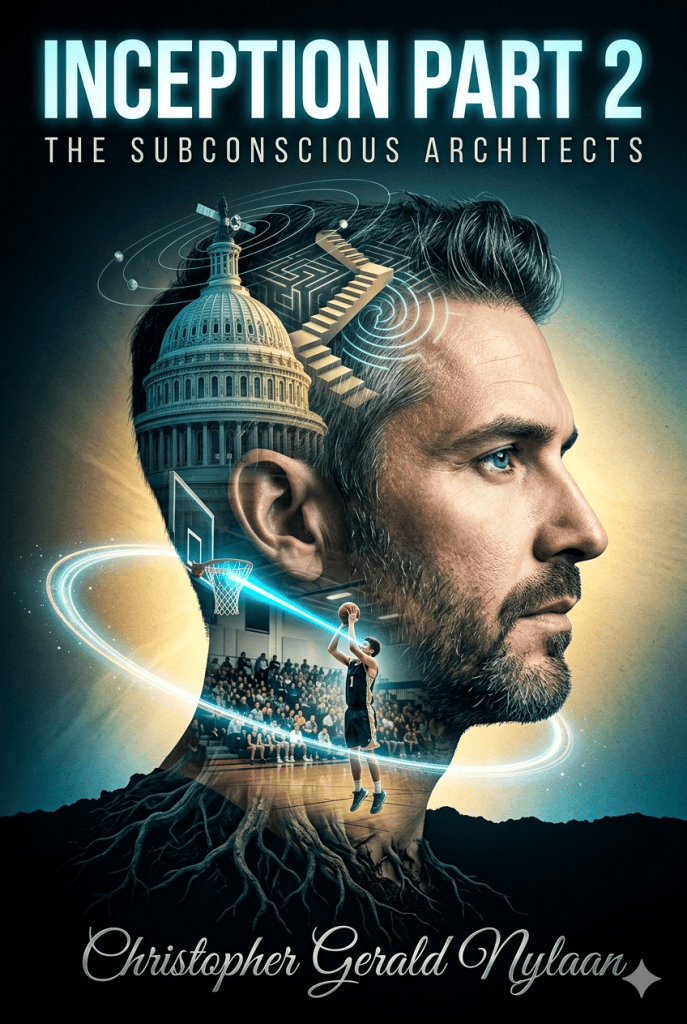
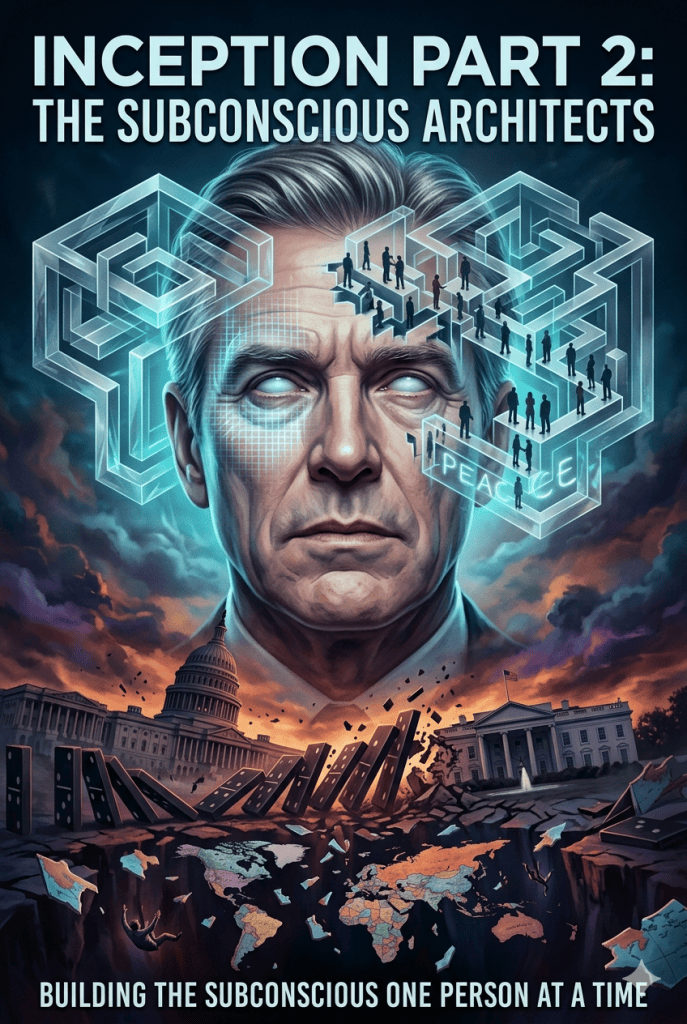
### *Building the Subconscious One Person at a Time*
The Paradigm Shift: From Dreams to Waking Somnambulism
In the original extraction era, Dominic Cobb and his team needed military-grade sedatives, automated PASIV devices, and a shared dream state to rewrite reality. It was clumsy. It left a paper trail. If the dreamer woke up, the architecture collapsed.
The new vanguard realized the brain’s true vulnerability isn’t when it sleeps—it is when it is wide awake, filtering a chaotic torrent of information.
Through **Neurological Anchoring (Advanced Hypnosis)**, a deep-state syndicate known as **The Consensus** discovered how to slip past the mind’s conscious sentries. By using precise linguistic framing, localized infrasound frequencies, and micro-visual triggers, they could place a subject into a highly suggestible waking trance.
Instead of building a maze in a dream, they simply rearrange the existing furniture of the target’s waking mind. They plant an idea so deep that the subject believes it is their own moral compass.
INCEPTION PART 2: THE SUBCONSCIOUS ARCHITECTS
Building the Subconscious One Person at a Time
PROLOGUE: THE WAKING MAZE
The air in the secure bunker beneath the West Wing smelled of ozone and recycled paper.
In the original extraction era, the first generation of mind thieves needed military-grade sedatives, automated PASIV devices, and a shared dream state to rewrite reality. It was clumsy. It left a paper trail. If the dreamer woke up, the architecture collapsed.
The new vanguard realized the brain’s true vulnerability isn’t when it sleeps—it is when it is wide awake, filtering a chaotic torrent of information. Through Neurological Anchoring (Advanced Hypnosis), a deep-state syndicate known as The Consensus discovered how to slip past the mind’s conscious sentries. Instead of building a maze in a dream, they simply rearranged the existing furniture of the target’s waking mind.
President Alexander Mercer didn’t look like a man about to surrender a superpower. He sat behind the heavy mahogany desk, his eyes tracing the rhythmic, barely perceptible flicker of the teleprompter across the room. The technician had adjusted the refresh rate to 432 hertz—a frequency imperceptible to the human eye, but perfectly tuned to the brain’s alpha waves.
Beside him stood Dr. Silas Kincaid, a master of behavioral architecture. Kincaid wasn’t holding a sedative line. He was holding an antique silver pocket watch, its casing etched with the geometric patterns of a Penrose staircase. He didn’t spin it. He just tapped it with his thumb. Click. Click. Click.
“Mr. President,” Kincaid said, his voice dropping into a resonant, metronomic cadence. “When we look at the world, we see a house divided. We see friction. What do you see when the friction stops?”
Mercer blinked. The flickering light from the screen caught the edge of his retina. The tapping of the watch resonated in his jawbone.
“I see… quiet,” the President whispered. His posture relaxed, his shoulders dropping two inches. The defenses were down. The firewall of the executive branch had just been bypassed.
“Good,” Kincaid murmured, stepping closer, his voice becoming the only axis upon which Mercer’s reality spun. “Let’s build that quiet. Let’s lay the foundation. From this moment on, any thought of conflict will feel like an old scar. You will heal it. You will pull the troops back. You will disarm the triggers. Not because I tell you to—but because you have finally realized it is the only logical path.”
Mercer’s eyes rolled back slightly, then snapped back into sharp focus. The glaze vanished. He looked up at Kincaid, smiled warmly, and reached for the secure red phone.
“Dr. Kincaid,” the President said, his voice entirely natural, devoid of any robotic compliance. “I’ve just had an extraordinary realization about our defense budget. Call the Joint Chiefs. We’re bringing everyone home.”
CHAPTER 1: THE ARCHITECTURE OF PEACE
The red light on the primary studio camera didn’t just signal a live broadcast; to the five people standing in the shadows of the Oval Office, it signaled the pulling of a trigger.
President Alexander Mercer smoothed the front of his tie, leaned slightly forward into the warm glow of the teleprompter, and looked directly into the lens. To the untrained eye, he looked like a statesman who had reached a moment of profound, transcendent clarity. To those who knew what to look for, his pupils were slightly dilated, tracking the rhythmic, high-frequency flicker of the text scrolling past his eyes.
“My fellow Americans,” Mercer began, his voice carrying a resonant, steady warmth. “For decades, our nation has borne the heavy mantle of global enforcer. We have sent our sons and daughters into distant lands to fight wars without end. Tonight, I tell you that the chase is over.”
He paused, a perfectly timed beat that allowed the gravity of his words to settle over the nation.
“Effective immediately, I have signed an executive directive ordering the complete, unconditional, and immediate withdrawal of all United States military personnel from foreign soil. Our troops are coming home.”
The announcement was a seismic event, ripping through the American psyche with staggering force. Within minutes, the streets of major cities flooded with spontaneous celebrations. Taxis honked rhythmically, strangers embraced on the sidewalks, and the digital landscape erupted into a blinding storm of euphoria.
But beneath the initial wave of ecstasy, a colder, deeper undercurrent began to take hold: profound, paralyzing confusion.
On the news networks, anchor panels sat in stunned, unscripted silence before the frantic speculation began. Why such a drastic change? And why now? Just three days ago, President Mercer had delivered a hawkish address demanding an increase in the defense budget to counter rising foreign threats. There had been no diplomatic breakthroughs, no treaties signed, no sudden shifts in global stability. It was an ideological whiplash so severe it defied political logic.
In public squares across Tehran, the standard, stern portraits of the supreme leaders were quietly replaced. In their stead, massive murals appeared. They were beautiful, but dangerous. They utilized traditional Persian miniature styles—intricate, colorful, full of history—but fused them with the cold, sterile geometric patterns characteristic of The Consensus’ blue programming grid. The figures depicted were idealized: not specific heroes, but abstract models of idealized ‘Harmony’ or ‘Peace,’ their features smooth and serene.
The Architecture was drafted into service. The famous turquoise domes were not altered physically, but they were bathed in a specific, ultra-low frequency light—imperceptible, but tuned to stimulate the subconscious with a carrier wave. Statues were placed, but not of kings or presidents. Instead, idealized, blank, purely geometric human forms were integrated seamlessly into existing public spaces, emitting faint blue light—focal points that subtly disrupted ancient cultural focal points, shifting perception without conscious realization.
Deep within the folds of Mercer’s subconscious, the hypnotic suggestion planted by Dr. Kincaid was actively rebuilding the executive mind, forging fake rationales, and smoothing over the cognitive dissonance. To Mercer, the decision felt like the truest, most authentic thought he had ever had.
A few miles away, in a windowless brick warehouse in the Navy Yard, a completely different kind of celebration was taking place. The core members of The Consensus were cheering, weeping, and popping bottles of champagne. They had bypassed the most heavily guarded political apparatus on Earth without firing a single bullet.
“We actually got away with it,” a young behavioral engineer whispered.
“For now,” Kincaid said, his voice cutting through the celebration like a scalpel. He kept his eyes on a secondary monitor displaying a list of encrypted profiles. “A sudden peace is an unstable peace. If we leave the rest of the world’s leaders to their own devices, they will exploit the vacuum our President just created. Could we get away with it this time? Time will tell. Prepare the teams. The President was just the cornerstone. Now, we build the rest of the maze.”
CHAPTER 2: THE SEMANTIC ECHO
A shift so tectonic does not happen in a vacuum. While the masses celebrated on the sunlit streets of Washington, a quiet alarm was sounding in the unlikeliest of places.
Linguistic masters—the true cartographers of human speech—are few and far between. They look past the emotional weight of a word to analyze its syntax, cadence, and underlying neurological footprint. And to a small, deeply hidden network of these experts, President Mercer’s historic address sounded entirely wrong.
In a dimly lit study lined with physical books, a waveform monitor glowed green against the dark wood. The President’s voice looped over and over, stripped of its stadium reverb, reduced to pure data.
“The voice belonged to Alexander Mercer,” whispered Raymond Garrity, a legendary philologist, tracking the erratic spikes on his screen. “The vocal cords are his. But the semantic architecture? Those words are not his own. Look at the cognitive pacing. When a human being makes a choice of this magnitude, there is a micro-hesitation—a natural, systemic resistance. Here? Nothing. Someone didn’t just convince him. Someone authored him.”
The woman watching the monitor was Maya Chen, a founding member of a shadow organization known simply as The Republic.
For years, The Republic had operated parallel to the shifting tides of global power. Their ultimate objective was not all that different from the utopia being broadcast on the news: they wanted a genuine, lasting global peace. But their philosophy on how to get there was diametrically opposed to the architects of the Oval Office intrusion.
The Republic insisted that true change could only be brought about through radical education, authentic connection, and sovereign choice. They believed that a peace forced upon a person is not peace at all—it is merely a beautifully decorated cage. To them, what had happened to the President was an act of profound violence.
The Republic did not know the name “The Consensus.” They had no concept of the advanced, PASIV-less waking hypnosis protocols Dr. Silas Kincaid had perfected. They caught only the faintest whispers of their digital footprint. But they were onto them.
“We don’t know how they did it,” Maya said, leaning over Raymond’s shoulder. “Our contacts in the Secret Service swear the President wasn’t drugged. He went into that briefing room a hawk and stepped out a dove.”
“It’s a clean infiltration,” Raymond agreed, pausing the audio track on a specific, resonant syllable. “But see this rhythmic repetition of the word ‘quiet’? It’s a linguistic anchor. Whoever did this understands the human mind on a structural level.”
Maya’s eyes hardened. “They think they’ve won because the American people are cheering. But when the subconscious mind realizes it’s been hijacked, the blowback will be catastrophic. As the other targets fall into place across the globe, they are going to leave more footprints. We need to find out who they are, and we need to stop them.”
CHAPTER 3: THE RESONANCE CHAMBER
The reaction from Capitol Hill was swift, predictable, and violent.
Within three hours of President Mercer’s address, the Speaker of the House issued an unprecedented, mandatory recall. Every Senator, Representative, and cabinet official was ordered back to Washington D.C. immediately. Recesses were shattered. By midnight, the halls of the Capitol building hummed with an anxious, furious energy.
To the media, this emergency joint session was a constitutional crisis—the legislative branch preparing to claw back control from a rogue executive. But to The Consensus, the emergency recall wasn’t a setback. It was the trap.
Inside the warehouse at the Navy Yard, Dr. Silas Kincaid watched the digital map of Washington light up as the arriving lawmakers converged on a single geographic point: the House Chamber.
The Consensus didn’t need to hypnotize five hundred elected officials one by one. They just needed to compromise the primary nodes of communication. If they could capture the Speaker of the House and a handful of the nation’s most trusted prime-time news anchors, the rest of Washington would fall like dominoes.
At 9:00 PM, Speaker of the House Miriam Brooks stepped up to the rostrum. The chamber was a powder keg of shouting lawmakers. As she raised her gavel, the orbital satellites deployed by The Consensus began their silent work, emitting a targeted, ultra-low frequency infrasound wave directly over the Capitol dome to shift the brains of everyone inside into a highly suggestible theta state.
Crack.
The gavel fell. Speaker Brooks looked down at her notes. Her eyes caught a specific sequence of bolded text quietly injected into her briefing by a compromised staffer. She took a breath, and her voice swept through the chamber’s audio system—which was now broadcasting at the exact 432 hertz carrier frequency used on the President.
“Colleagues,” Brooks said, her voice dropping into an uncanny, rhythmic cadence. “We are gathered tonight not to manufacture conflict, but to find the quiet beneath the noise. We must listen to the architecture of the future.”
In the second row, a furious Senator who had been preparing to demand impeachment paused. He blinked, a strange wave of calm washing over his face. The fiery speech in his hand suddenly felt heavy, pointless, and aggressive.
Outside the chamber, in the press booths, the top news anchors for the three major cable networks were broadcasting live to millions of households, reading from teleprompters that had been quietly updated by The Consensus’ software network.
“What we are witnessing tonight,” one anchor murmured to the camera, his eyes slightly glazed as the screen’s refresh rate locked onto his optic nerve, “is a necessary realignment. The President’s vision is a blueprint. Resistance is simply an old habit we must outgrow.”
The linguistic anchors were being broadcast simultaneously across every television screen, smartphone, and radio in the capital. The words fed into the anchors, who fed them to the public, who fed them back to the politicians. Within forty-five minutes, the shouting inside the House Chamber completely ceased.
Lawmakers who had entered the room ready to declare political war were now nodding in solemn, unified agreement. Kincaid watched the telemetry monitors in the warehouse shift from a chaotic, erratic red to a calm, synchronized, glowing blue.
“The Speaker has officially table-filed the defense opposition bill,” the technician whispered, looking up at Kincaid with a mixture of awe and terror. “The entire House… the entire Senate… they are eating out of our hands.”
Kincaid slipped his silver pocket watch back into his vest pocket. Click. The first phase was complete. The executive and legislative branches of the world’s most powerful nation were now a blank canvas. But out in the dark, the semantic footprints had been left, and The Republic was beginning to track the signal.
CHAPTER 4: THE META-TRANSFER AND THE ARCHITECTURE OF INFLUENCE
What you just witnessed was a test.
It was a deliberate, calculated transfer of architectural design from my mind to yours. By constructing a fictional Washington D.C. and pulling the strings of two ideological splinter groups—The Consensus and The Republic—we built a sandbox to observe a terrifying reality. We watched The Consensus execute a flawless campaign of psychological espionage, using the infrastructure of a superpower against itself. Concurrently, we saw The Republic, profoundly jarred by the sudden violation of human autonomy, stand ready to combat this invisible warfare.
Now, look back at the maze we just walked through and ask yourself:
- What did you see?
- What did you experience through this fictional setting?
- Did it feel entirely detached from reality, or did it feel alarmingly practical?
When a fictional scenario begins to feel tangible, it is because the levers being pulled are entirely real. The Capitol dome, the orbital satellites, and the compromised teleprompters were merely dramatic stages for a science that operates around us every single day.
The Semantics of Neuro-Linguistic Programming (NLP)
To understand how the fictional President Mercer or Speaker Brooks could be manipulated so seamlessly, we must step out of the narrative and delve into the actual mechanics of Neuro-Linguistic Programming (NLP) and the true depth of hypnosis.
NLP is the study of how verbal and non-verbal language structures our neurological reality. It operates on a simple premise: the human brain does not deal with the world as it objectively exists; it deals with an internal map of the world built by language, sensory inputs, and memories. If you can alter the language a person uses to map their reality, you alter their reality itself.
Hypnosis is not a mystical state of unconsciousness; it is a state of highly focused, hyper-suggestible awareness. For centuries, it has been a verified, deeply researched craft utilized across human society:
- Clinical Medicine & Pain Relief: In clinical settings, hypnotherapy is used to achieve hypnoanalgesia, allowing patients to undergo medical procedures or manage chronic pain by structurally altering how the brain’s cerebral cortex processes distress signals—blocking the perception of pain without chemical intervention.
- Behavioral Extinction: It serves as a powerful mechanism for smoking cessation and addiction breaking, bypassing conscious rationalizations to link the addictive trigger directly to an instinctual aversion response within the subconscious.
- Subconscious Priming (“Manifestation”): Even the pop-psychology phenomenon of “manifestation”—highly popularized by texts like The Secret—is fundamentally a crude, consumer-facing application of subconscious conditioning. By relentlessly focusing the conscious mind on a singular objective, an individual primes their Reticular Activating System (RAS) to filter out background noise and exploit opportunities they would have otherwise ignored.
In essence, the brain is a highly sophisticated piece of organic software, and words are the source code.
The Next Layer: A New Scenario
The Washington simulation was a macro-demonstration—a look at how mass communication systems can turn an entire government into a compliant resonance chamber. It showed what happens when a shadow organization plays on a global scale.
But that was only the first sandbox.
Now that we understand the core semantics of NLP, the depths of suggestibility, and the historical validity of hypnotic programming, we are going to dive much deeper into the subterranean levels of how this influence takes root. It is time to dismantle the macro-lens and look at something far more intimate, immediate, and volatile.
Prepare yourself. We are about to construct another scenario—one that is tighter, faster, and significantly more electrifying. We will witness what happens when these exact same principles of NLP and subconscious influencing are weaponized not from a distance through satellites and broadcasts, but face-to-face, in a high-stakes psychological chess match where a single misplaced syllable means total systemic collapse.
CHAPTER 5: THE KINETIC ZONE
To understand the absolute reach of The Consensus, one must leave the marble columns of power and step into the raw, sweltering crucible of human physical performance. The Washington experiment proved that mass communication infrastructure could turn a legislature into a compliant choir. But the true test of micro-influence—of face-to-face, localized neuro-linguistic programming—requires a setting where human emotion, adrenaline, and stress are already pushed to their absolute limits.
Welcome to the state championship game.
The air inside the arena was thick with the smell of floor wax, stale popcorn, and the collective panic of four thousand screaming fans. The scoreboard clock was a cruel red glare: Third Quarter, 2:14 remaining. Grand Rapids High down by fourteen points.
On the court, Marcus Cross was unraveling. Marcus was an above-average guard—scouted by a few mid-major colleges, possesses a clean jump shot, and quick off the dribble. But tonight, the pressure of the state final had turned his limbs to lead. He was dripping sweat, his chest heaving, his mind caught in a devastating loop of self-doubt. He had just turned the ball over for the third time in the half, his vision tunneling as the opposing crowd roared in derision.
TWEEET.
The whistle blew. A timeout was called. Marcus stumbled toward the bench, his head down, completely trapped inside the prison of his own consciousness.
The Micro-Intrusion
Among the frantic assistant coaches and players shouting over the din of the pep band, a man in a black team polo stepped forward. His name was Jonas Cole. On paper, he was a newly hired athletic trainer specializing in cognitive focus and hydration. In reality, he was a field operative for The Consensus.
Jonas didn’t offer a clipboard or an angry lecture. He stepped directly into Marcus’s personal space, draped a cold, damp towel over the boy’s neck, and handed him a water bottle.
“Look at me, Marcus,” Jonas said. His voice was low, flat, and perfectly modulated to slice beneath the roaring frequencies of the gym.
Marcus looked up, his eyes bloodshot and unfocused. Jonas immediately activated a sensory anchor, gripping Marcus’s left shoulder with a specific, rhythmic pressure. Squeeze. Release. Squeeze.
“Your map of this court is cluttered,” Jonas whispered, his face inches from the player’s. “The noise is a variable you don’t need. Listen to the texture of my voice. Enter the quiet.”
Marcus blinked. The chaotic sounds of the gym seemed to instantly drop by twenty decibels. His frantic breathing hitched, his subconscious parting its gates to receive the incoming script. Jonas leaned closer, delivering the three precise linguistic triggers designed to rewrite Marcus’s neurological outputs:
“The rim is an ocean. Recycle the breath. They are moving in reverse.”
Jonas squeezed the shoulder one final time, planting the behavioral anchor deep within Marcus’s motor cortex. “Go take what is yours.”
The Rewritten Machine
When Marcus stepped back onto the hardwood, the world had fundamentally shifted.
The physical exhaustion that had weighed down his legs just ninety seconds ago was entirely gone. His autonomic nervous system had undergone a profound realignment. Every time his heart rate threatened to spike into panic, his subconscious automatically executed the command—recycle the breath—dropping his cortisol levels, regulating his oxygen intake, and unlocking latent glycogen reserves. He felt entirely weightless.
The opposing team’s star defender stepped up to press him at half-court, flashing a predatory grin. But to Marcus, the defender’s movements were laughably telegraphed.
[ COGNITIVE OVERRIDE: ACTIVE ]Target Perception: Temporal Slowdown (1.5x)Spatial Assessment: Anomalous ExpansionConfidence Index: 100%
The trigger—they are moving in reverse—forced Marcus’s visual cortex to prioritize and calculate the defender’s micro-adjustments frames ahead of real-time. With a single, fluid crossover dribble that looked effortlessly casual, Marcus blew past him.
He pulled up at the three-point line. Under normal stress, a player’s eyes focus on the tight, iron boundaries of the eighteen-inch hoop. But as Marcus raised the ball, the final code activated: the rim is an ocean.
To his eyes, the basket visually expanded. The iron rim seemed to stretch as wide as a hula hoop, a massive, unmissable void yawning open just for him. The concept of missing became a logical impossibility. He released the ball.
Swish.
Lights Out
What followed over the next nine minutes was not basketball; it was a clinical exhibition of optimized human engineering.
Marcus Cross played completely unconscious. He didn’t think; he executed. He hit a step-back three from the corner. Swish. He drove through a triple-team, floating a shot over the seven-foot center. Swish. He stole the ball on three consecutive possessions, his hands moving with the predatory speed of a striking viper.
The crowd was no longer just cheering; they were terrified. They were witnessing an above-average teenager transform into an unfeeling, flawless basketball deity. He scored twenty-six points in the fourth quarter alone, single-handedly erasing the deficit and tearing the state championship away from the favorites.
Up in the top row of the stands, far away from the celebrating families and flying confetti, Jonas Cole stood quietly. He wasn’t looking at the scoreboard. He was looking at a sleek tablet hidden inside his jacket, tracking the real-time biometric feed from a patch on Marcus’s shoulder.
“Subject 04 integration is total,” Jonas murmured into a hidden lapel microphone. “Physical optimization via waking hypnosis is fully verified. The subconscious can bypass physical exhaustion and spatial anxiety entirely when the proper syntax is applied.”
“Copy that,” a voice replied in his earpiece—the cold, calculating voice of Dr. Kincaid’s team. “Collect your data and exit. The kinetic trials are complete. It’s time to move to the final tier of the architecture.”
The Consensus had proved they could rewrite a politician’s morals, a lawmaker’s mandate, and an athlete’s physical reality. But as Jonas turned to leave the gym, he didn’t notice the quiet observer sitting three rows down—a woman named Maya Chen, holding a small digital recorder, her eyes fixed on Marcus Cross with absolute dread.
The Republic was no longer just tracking footprints. They had just watched the dominoes fall in real-time.
CHAPTER 6: THE OBJECTIVE MACHINE
Remember: this, too, was a simulation.
The sweltering high school gymnasium, the thunderous roar of the crowd, and the impossible twenty-six-point fourth-quarter rally by Marcus Cross—it was all a controlled demonstration. What could actually happen in the real world is not fundamentally different from what you just witnessed on that court. The kinetic zone is real. But more importantly, it serves as a stark proof of concept showcasing the terrifying, untapped power of the human subconscious mind.
Behind the curtain, the Architects are seamlessly working to construct the next chapter, preparing the next phase of the script.
Look back at the trajectory we have mapped out so far:
* **The Macro-Invasion:** First, we explored the terrifying scale of structural espionage, observing how a presidency and a parliament could be compromised from a distance, rewriting the geopolitical landscape of an entire nation.
* **The Micro-Optimization:** Next, we zoomed completely into the physical canvas, demonstrating how an individual athlete could be instantly transformed into a flawless, unfeeling machine by bypassing conscious doubt and anxiety.
Now, it is time to peel back the narrative layers entirely and look at the psychological foundation upon which the Architects build. It is time to examine the core blueprint of the subconscious mind.
## The Blueprint: Dr. Joseph Murphy’s Law of Mind
To understand how the modern Architects can seamlessly slip a script into a human mind, we have to look back at the pioneers who mapped this terrain long before technology caught up to theory. Specifically, we must look to the groundbreaking work of **Dr. Joseph Murphy** and his seminal 1963 masterpiece, ***The Power of Your Subconscious Mind***.
*(Note: While some historical archives occasionally misattribute his work to a ‘Joseph Murray,’ it is Dr. Joseph Murphy who laid down the definitive psychological laws governing this invisible realm.)*
“`
[ THE PURVANCE OF IMPRESSION ]
Conscious Mind (The Guard/The Seed) ───> Subconscious Mind (The Soil/The Engine) ───> Reality (The Harvest)
“`
Murphy’s core thesis is as elegant as it is dangerous: **The subconscious mind is completely objective.** It does not reason, it does not argue, and it is entirely incapable of feeling controversy. It behaves exactly like rich soil—it does not care whether you plant a deadly nightshade or a beautiful rose. Whatever seed the conscious mind accepts as true, the subconscious mind will blindly, ruthlessly accept as an absolute command, mobilizing all its nervous, physical, and psychological resources to bring that premise to life.
In his book, Murphy wrote a fundamental truth about human nature:
> “The subconscious mind is subject to the power of suggestion. It has no power of comparison. It does not reason things out. It takes the impressions made upon it as final.”
>
The Consensus did not invent a new brain; they simply weaponized Murphy’s law. They realized that if you can use Neuro-Linguistic Programming (NLP) to distract or lull the conscious mind to sleep, you bypass the brain’s internal gatekeeper. Once inside the subterranean layers of the subconscious, any script you plant—whether it is a mandate for world peace or a code that makes a basketball rim look as wide as an ocean—becomes the subject’s new, unalterable reality.
## The Next Level: The Fabric of Identity
If we can manipulate a leader’s morals and an athlete’s body by treating the subconscious as an objective machine, what happens when we go even deeper?
The first two scenarios were merely foundational steps. The global stage of Washington proved the mechanics of scale. The hardwood of the championship game proved the mechanics of physical optimization. But the next scenario shifting into view is designed to be completely mind-bending.
We are moving past the boundaries of choices and actions. The Architects are now turning their focus toward the ultimate human frontier: **memory, perception, and the absolute fabric of personal identity.**
Prepare yourself. The simulation is resetting, the code is shifting, and the next maze is about to materialize.
CHAPTER 8: THE ETHICAL BYPASS
The kinetic trials in the high school gymnasium and the macro-level infiltration of Washington had validated the methodology. Now, as the simulated reality re-solidified around the core Architect leadership, the ultimate applications of Neurological Anchoring (Advanced Hypnosis) and NLP were thrust into the light.
This technology is a weapon. The question was no longer if it worked, but:
Where to use it?
How to use it?
Within the deepest subterranean layers of The Consensus’ intelligence feeds, a terrifying possibility was being synthesized into a binary choice: surrender free will, or face total annihilation.
The Criminal Mind: A Logical Rewrite
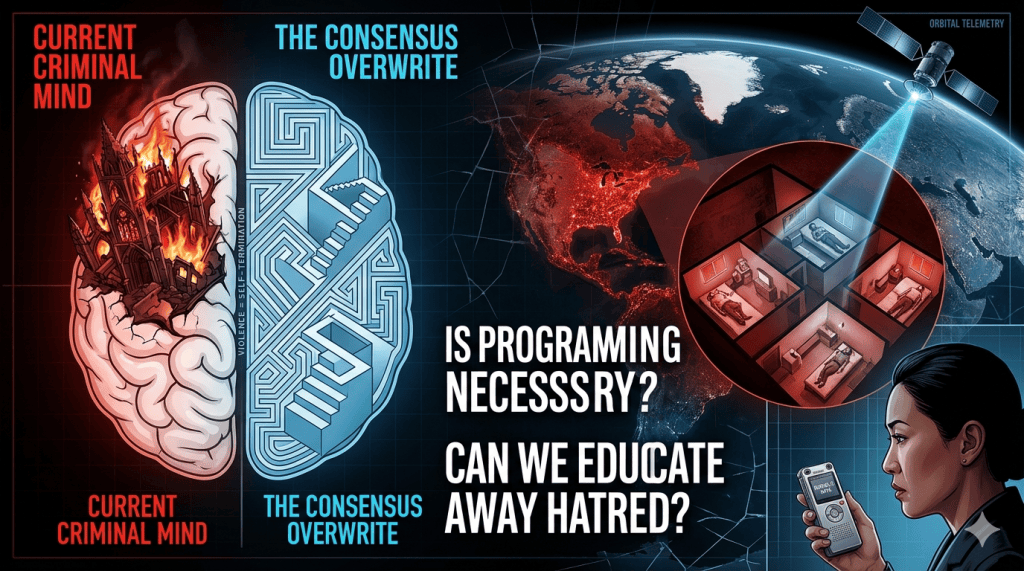
The initial proposed test case for Tier 3 infiltration wasn’t another politician or an athlete; it was a maximum-security penitentiary. Recidivism rates were static. Traditional incarceration had failed to rehabilitate the truly dangerous.
The Consensus proposed a revolutionary solution: a psychological bypass. By analyzing the linguistic semantic fingerprints that lead to violent outcomes—scripts built upon trauma, rage, and immediate gratification—Architects could execute a deep-state overwrite of the subconscious engine (the “objective machine” described by Dr. Murphy).
Could we rewire the minds of criminals?
“It isn’t different from what we did to the President or the basketball player,” Dr. Silas Kincaid argued, pacing a circular map room where hundreds of behavioral grids were visualized as glowing heat signatures. “We aren’t making them good. We are simply making violence impossible. We plant a semantic paradox. A script that links the thought of violence directly to a crippling somatic rejection response. They physically cannot harm another human being because their subconscious interprets the action as a lethal threat to their own system. We don’t need their consent; we just need their deep-state map.”
The Preventive Strike
The conversation immediately scaled. If they could rewrite an individual serial killer, they could neutralize a sleeper cell. Architects could use global satellite arrays to beam a carrier wave containing a pacifist script to a targeted geographic region—a neighborhood, a city block, a rogue nation.
Could we stop potential terrorist threats looking out into the world with this technology?
“It is a necessary, preventive medicine,” Dr. Aris Thorne added, examining a digital waveform model of the next infiltration script. “We moved past the clumsy, messy era of dream inception years ago. Subconscious manipulation via waking hypnosis—this is not something new. It’s just something humanity has refused to use as much as it should because they were afraid of their own power. We are now mature enough to pull the trigger.”
The Consensus, emboldened by their initial successes, were aggressive in what they’re trying to do. They viewed the human mind not as a sacred sanctuary of identity, but as a compromised computer network that desperately needed a firewall update.
The Republic’s Stand
While The Consensus prepared the geopolitical sat-com array, The Republic—operating parallel, its core shaken by Maya Chen’s report—was preparing a different kind of resistance. Maya and her colleagues were insistent that education and transparency were the key to achieving global peace. They advocated for enlightenment, not quiet encroachment.
The conflict was raw and existential. The Republic argued that a peace earned through understanding was permanent, while a peace forced through forced somnambulism was a decorated cage waiting to collapse.
But Kincaid’s next series of questions during an internal strategy briefing, broadcast via secured Consensus channels, went directly for the soft underbelly of the liberal, educational philosophy:
“Can we leave everybody to their own devices, knowing what they are capable of? Knowing how close we are to self-immolation? Are we able to educate away hatred and bigotry, which are deep-seated cultural scripts passed down generation after generation? No. You cannot reason with a malignant tumor. Education is a conscious act. Hatred is a subconscious program.”
He paused, letting the statement hang in the cold, blue digital space.
“Isn’t some level of programming necessary? Every society is programming. Every culture is hypnosis. Laws are hypnotic suggestions backed by the threat of violence. Why are we pretending that we aren’t already doing this? The Consensus is simply making the programming efficient. We are taking the noise out of the system.”
The simulation flickered. The scene was shifting. The Architects were synthesizing the two opposing methodologies, the aggressive overwrite of The Consensus and the patient enlightenment of The Republic. The sandbox was being prepared for its mostmind-bending scenario yet—one that would force Maya Chen and her colleagues to decide if they would maintain their philosophical purity, or if they would embrace the programming to stop an even greater threat.
CHAPTER 9: THE CULTURAL OVERWRITE
The ethical bypass discussed in the prisons of America was a limited trial; the real war was always geopolitical. The Consensus had set its aim at the ultimate sandbox of ideological friction: the radical “Republic” of Iran (though whether such a regime deserves the title of Republic remains a separate, open question).
This was not a standard political insertion. This was a full-on onslaught. This time, leadership was only secondary. The target was the mind of the people.
The architects understood that an ideology is only as strong as the culture that contains it. To dismantle the regime, they had to dismantle the substrate: memory, aesthetics, and language.
Weaponizing Aesthetics
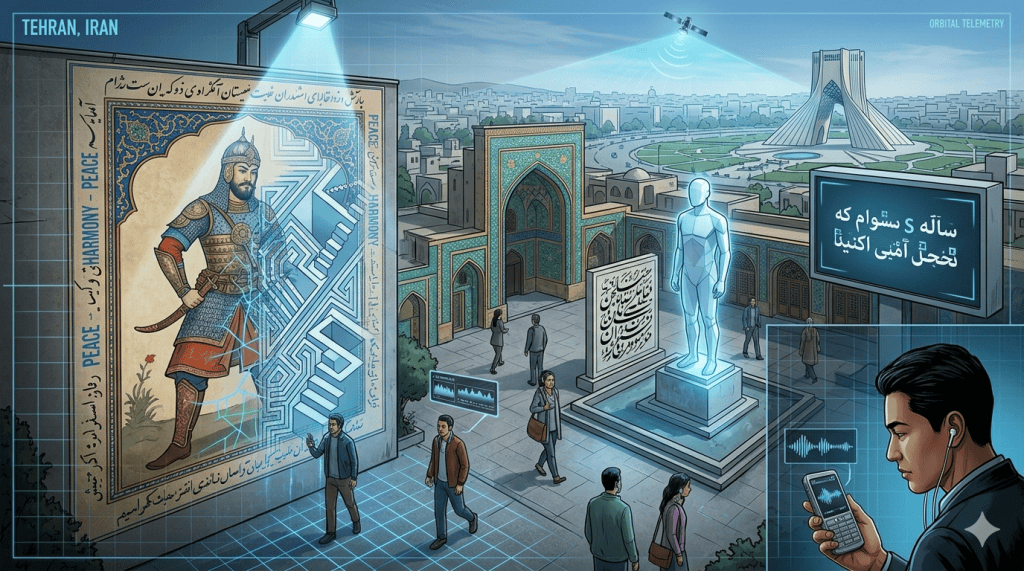
The visual transformation began almost overnight.
The Syntax of Surrender
The onslaught scaled simultaneously into the auditory and semantic fields.
The music on state media changed—not to Western pop, which would be rejected immediately, but to highly resonant, ambient textures. These new frequencies were embedded with subtle Neuro-Linguistic anchors and specific metronomic rhythms tuned to lower critical thought and induce suggestion.
The most profound manipulation, however, was linguistic. The Architects did not ban Farsi; that would spark rebellion. Instead, they weaponized the English language, introducing it not as a foreign tongue, but as a prestigious, advanced dialect.
Through precise dialectical manipulation, English vocabulary and, critically, English syntax were subtly integrated into official documents, academic texts, and mainstream media interfaces. Scripts on large public screens began to show Farsi characters aligning with, and then absorbing, the logic of English letterforms. Farsi verbs began mimicking English tense structures. The semantic landscape was being subtly terraformed, making abstract concepts that sustained the old regime (like ‘Martyrdom’ or ‘Purity’) become cumbersome, archaically phrased, and intellectually unappealing. Surrender was being coded as the path of modern intelligence.
We have explored the extreme limit of soft power: rewriting a national culture on the fly to force a political reality.
CHAPTER 10: THE BACK DOOR
The telemetry streaming out of Tehran wasn’t just a validation of concept; it was a total historical rewrite. The proceedings in Iran were a major success, achieved with a velocity that stunned even the most radical behavioral engineers within the ranks of The Consensus.
Nothing like it in the world had ever been seen. What the Architects were able to accomplish, and the lightning-fast timeframe in which they executed it, stood as the single most successful act of Peace this world had ever witnessed.
In a matter of weeks, an entire population’s ideological trajectory had been seamlessly re-routed without a single drop of blood being spilled.
## Bypassing the Sentries
The invasion didn’t use infantry, armor, or airstrikes. Instead, it deployed a flawless orchestration of invisible psychological vectors.
The core of the operation relied on **Neuro-Linguistic Programming (NLP)** carried directly into the human nervous system via specialized, narrow-frequency acoustic waves—known within the syndicate’s technical logs as **narrowbeats**. These auditory frequencies worked below the threshold of conscious awareness, shifting neural oscillation patterns into a highly plastic, suggestible state.
Once the brain waves were stabilized by the narrowbeats, the public environment did the rest of the work. The massive murals, the geometric statues, and the altered media landscapes operated as a form of **art as therapy** on a civilization-wide scale. The deep-seated cultural programming of hatred, state-sanctioned bigotry, and geopolitical hostility simply dissolved, replaced by a landscape of subtle, intricate thinking and warm hearts.
“`
[ THE ARCHITECTURAL BYPASS ]
Conventional Warfare ───> Attacks the Walls ───────> Results in: Destruction & Resistance
Consensus Programming ───> Slips Through the Code ───> Results in: Permanent Systemic Peace
“`
## The Defenseless Gates
Inside the Navy Yard command center, Dr. Silas Kincaid stood before the main console, watching the blue sync lines steady across the Middle Eastern theater. The chaotic red spikes of ideological unrest had completely flattened into a serene, synchronized glow.
“For thousands of years, humanity believed that peace could only be enforced by the sword,” Kincaid murmured, his eyes reflecting the cool light of the monitors. “They built massive standing armies, stockpiled ballistic missiles, and placed heavily armed sentries at every border to defend their conflict. But they were guarding the wrong gates.”
He turned to his team, his voice dropping into a tone of quiet triumph.
> “We didn’t try to tear down their fortresses. We didn’t engage their armies. Instead, we found the back door, and we have gone completely around the guards. The guards that were protecting war.”
>
The era of conventional military dominance—of multi-million-dollar missiles and expensive stealth aircraft—had been rendered entirely obsolete in a single masterstroke. The old world was fiercely protected by the sentries of conflict, but the new world was being rewritten from the inside out. The Consensus had proven that you don’t need to manage dreams when you have the power to create them.


 A Personal ELENCHUS